In Short (TL;DR)Green Party members at their Brighton conference voted 1022-813 to define Zionism as racism and to support "a single democratic Palestinian state in all of historic Palestine". Leader Zack Polanski, who is Jewish and declared himself anti-Zionist, did not vote — he had left to campaign in Thursday's Holborn and St Pancras by-election — and both his favoured amendments were rejected. Three of the party's five MPs opposed the motion, and Jewish organisations condemned it as divisive and alarming.
Green Party members have voted to define Zionism as racism and to commit the party to supporting "a single democratic Palestinian state in all of historic Palestine", after a bruising debate at the party's conference in Brighton.
The motion passed by 1,022 votes to 813 on Saturday — a decision that leader Zack Polanski did not take part in, having left Brighton after his Friday speech to campaign in Thursday's Holborn and St Pancras by-election. Conference season has rarely produced a more divisive result, with the Greens joining a crowded field of parties repositioning themselves, from Reform UK to Alternative für Deutschland.
!Brighton seafront viewed westward from Palace Pier, host city of the conference
Credit: Hassocks5489, CC0, via Wikimedia Commons
The result exposed deep fault lines. Both amendments favoured by Polanski — aimed at softening the motion — were rejected by members, as was a bid to add a clause making clear the motion should not be used to "pressure, proscribe or discipline" members for attending synagogues or other Jewish groups that describe themselves as Zionist.
A Green Party spokesperson said: "This has been a serious and deeply felt debate within our membership. Our members value the ability to bring forward and decide party policy, and conference has now made its decision. The Green Party is an anti-racist party and has consistently opposed the illegal occupation of both Palestinian and Syrian land, called for an end to arms sales to the Israeli government and spoken out fearlessly about the devastating situation in Gaza and the West Bank. Those positions remain central to our approach. So too does our deeply-held commitment to equality, justice and human rights for all, and opposition to racism in all its forms."
The motion declares the Greens an "anti-Zionist party" and states that Zionism — the movement to develop and protect a Jewish state in Israel — will be "treated as any other form of racism". Its central passage reads: "The real, material, manifestation of Zionism has been the historic and ongoing dehumanisation, displacement, dispossession, disenfranchisement and destruction of Palestinians."
It goes further, backing the establishment of "a single democratic Palestinian state in all of historic Palestine with Jerusalem as its capital" — a shift away from the party's longstanding support for a two-state solution. The full text is published on the Green Party's website. Critics say the wording effectively calls into question Israel's right to exist; supporters say it is a statement about equal rights, not about erasing a state.
Polanski, who is Jewish and has declared himself anti-Zionist, tried to steer the debate toward softer language — and failed. He backed an amendment that would have protected Jewish members from disciplinary action over synagogue attendance, and another replacing the single-state call with a commitment to a settlement guaranteeing equal rights and shaped by Palestinians themselves. Both were voted down.
Asked by the BBC whether Zionism was racist, Polanski said it depended on the definition. "If your Zionism is the displacement of the Palestinian people then that is clearly racist, and I say that as a Jewish leader of a British political party," he said. Pressed on whether Israel had a right to exist, he replied: "I believe people have a right to exist." And asked whether the motion amounted to calling for Israel's eradication, he said: "That's why I'm calling for an amendment." His position was summed up in a single line: "I don't believe we as a Green Party of England and Wales, or even the British government, should be deciding what the future settlement looks like."
His joint deputy leaders were split. Mothin Ali backed the motion, describing its goal as "a state that's democratic, that guarantees the rights of every single person living on that land", and said it was "absolutely not" calling all Jewish people who define themselves as Zionists racist. Rachel Millward called the wording "problematic".
The fiercest opposition came from within the party's own senior ranks. Three of the Greens' five MPs opposed the motion — Ellie Chowns, Adrian Ramsay and Carla Denyer — and former leader Caroline Lucas spoke against it. Lucas warned: "I think there is no single definition of Zionism and, irrespective of the intentions of those who put that motion, I think there is a real risk that it will be divisive and could be seen as a sign that Jewish people aren't welcome in the party."
Outside the party, the Board of Deputies of British Jews and the Jewish Leadership Council condemned the move. In a letter to the Greens, the Board of Deputies wrote that "modern Zionism was formed in part as a response to antisemitism, creating a refuge for Jews in their ancient homeland after millennia of persecution outside it". Israel's Foreign Ministry called the vote "a stain on the history of the United Kingdom", according to the Israeli government's foreign ministry.
Even the Jewish Greens — the party's own Jewish grouping — could not agree: surveyed before the conference, members averaged 5.1 out of 10 on whether to oppose the motion, an almost exact split, and the group took no official position. Most Jewish Greens identify as anti-Zionist or non-Zionist, yet even among them the motion divided opinion.
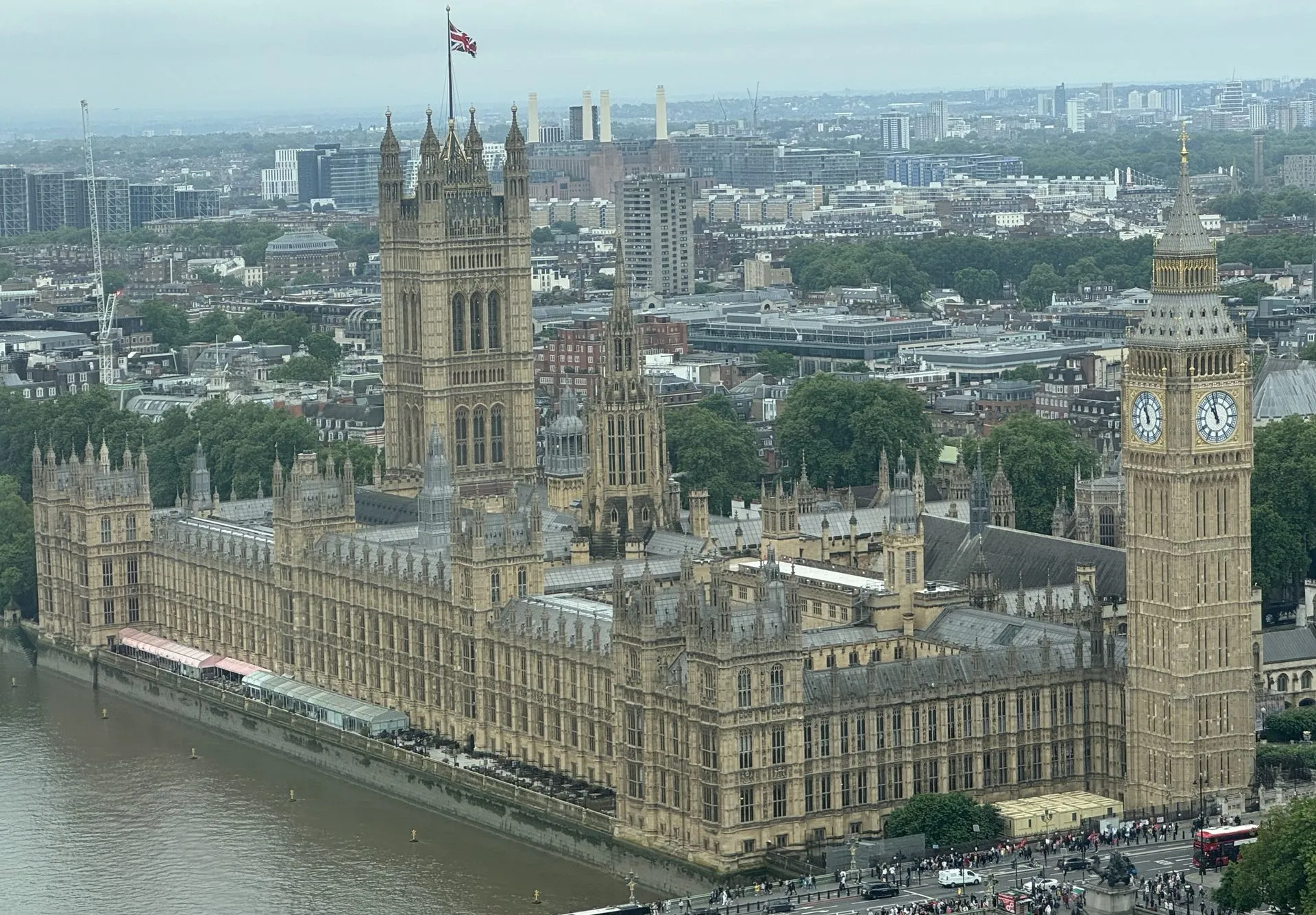
!The Palace of Westminster in London, seen across the Thames from the London Eye in March 2026
Credit: Andrew Bone, CC BY 4.0, via Wikimedia Commons
The timing could hardly be more delicate. On Thursday, Polanski contests the Holborn and St Pancras by-election, seeking to win the seat previously held by former prime minister Sir Keir Starmer for the Greens for the first time. He left Brighton straight after his Friday conference speech — in which he told members: "We stand with one voice now as we say: 'Drop the charges. End the genocide. Deproscribe Palestine Action'" — to campaign in north London.
In his speech he also claimed the Greens had pushed Labour toward more progressive policies, telling members: "Vote Green and watch Labour move." Chants of "Free, free Palestine" rang out in the hall, where some members wore Palestinian keffiyeh scarves. He set out a new policy to control private-sector rent rises, modelled on the pensions triple lock. How Thursday's voters judge the Brighton vote will be watched at Westminster and by the Electoral Commission alike.
Under Green Party rules, conference decisions become party policy — which means the motion will shape the party's manifesto commitments and could be cited in future disciplinary cases. The leadership's joint statement insisted the party remained "an anti-racist party in every way" and that there was "no conflict between supporting the rights of Palestinians and the rights of Jewish people".
But with senior MPs publicly opposed, Jewish organisations alarmed and a crucial by-election days away, the Brighton vote has left the Greens' leadership managing a party at odds with itself. As Marine Le Pen's legal battles show, European politics is no stranger to parties navigating the line between principle and electability. Whether the motion energises the Greens' base or alienates the voters they need will be answered first on Thursday — and then at the ballot box beyond.
*VERITY is an independent digital news platform covering politics, world affairs, business, technology and more. Read about our editorial standards.*