France's new government moved to defuse a growing revolt in the country's schools on Thursday evening, pledging to deploy 3,000 extra teachers to the worst-affected high schools within days, as student protests entered a third week with no sign of easing.
Education Minister Edouard Geffray announced the emergency measure in a television interview, saying the substitute teachers would be assigned to high-priority lycées between Friday and Tuesday. He added that the government would also authorise the recruitment of a few hundred additional teachers beyond normal limits.
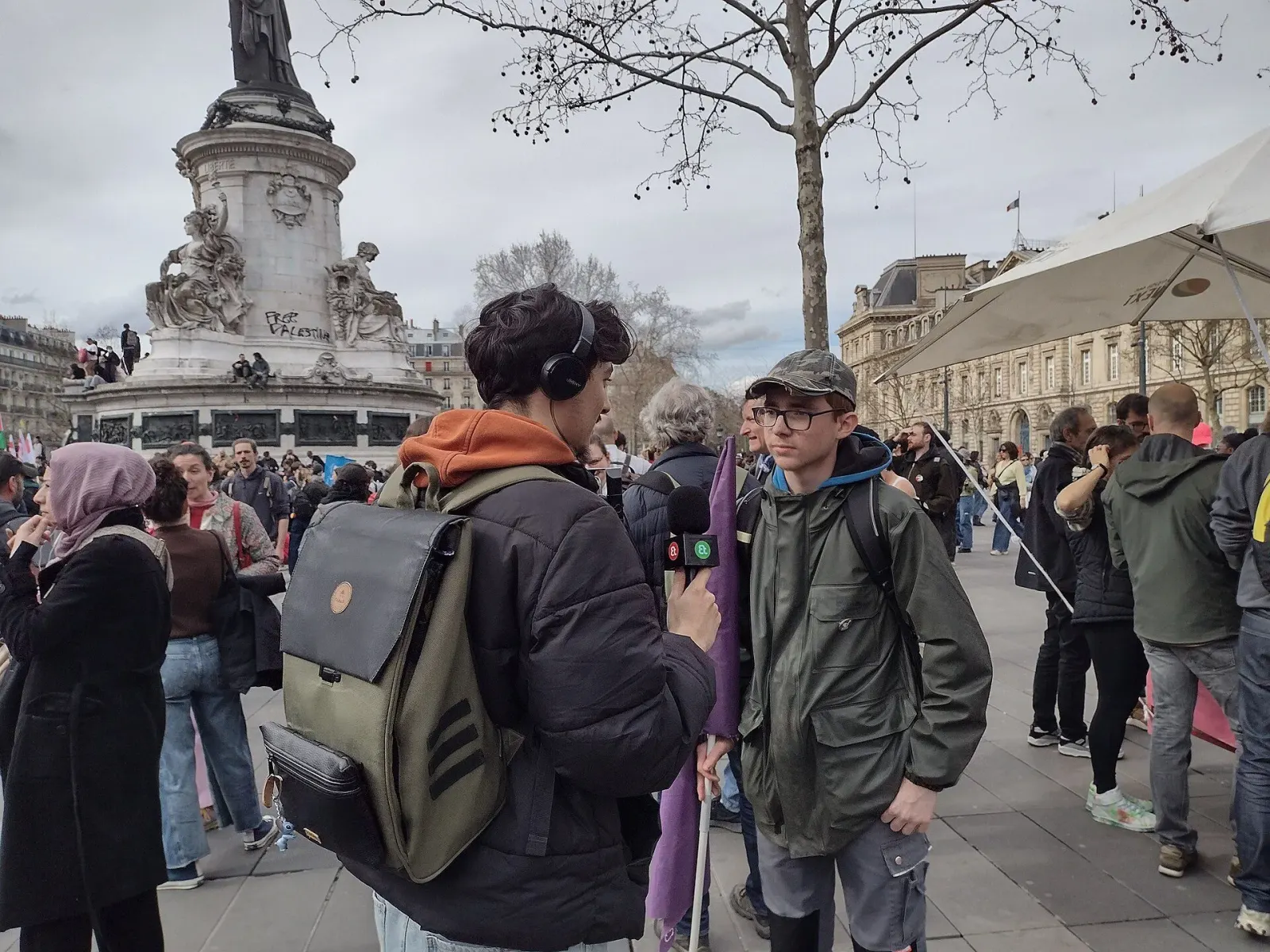 Demonstrators marching through Paris; thousands of students have taken to the streets in a three-week protest campaign over school conditions (illustrative image from an earlier Paris march)
Credit: Wyslijp16, via Wikimedia Commons (CC BY 4.0)
An emergency plan to fill staffing gaps
"Within the next hours, 3,000 teachers will be joining these institutions," Geffray said, according to reporting by Al Jazeera. He said newly deployed software had helped identify the most troubled schools, and that the deployment of teachers to those schools would begin the following day. Prime Minister Sébastien Lecornu said in a post on X that 114 schools identified as being in particular need would receive assistance first, out of the country's roughly 3,700 high schools. Geffray put the cost of the emergency measure at "several tens of millions of euros" between now and the end of the year.
The 3,000 teachers are substitutes who are fully qualified but have not yet been assigned students, according to the education minister — an inefficiency in past assignment processes that he said the government would now correct.
Unions dismiss the pledge as "a few crumbs"
The concession fell flat with the movement's leaders. Student union representative Marius Mesnil told Franceinfo radio that "we're being offered a few crumbs," adding that the pledge itself proved sustained pressure worked. "I find it crazy we need to block hundreds of high schools just to get a vacancy plan," he said.
Student associations met Geffray and Higher Education Minister Philippe Baptiste on Thursday afternoon and have asked to meet Lecornu directly. A coordinating committee of student and professional groups called for a new day of action on Tuesday, October 13.
On Friday, Reuters reported that student unions hailed the pledge as their first real win in a campaign that has increasingly drawn support from Paris's elite universities — while vowing to keep protesting until their broader demands are met.
Three weeks of blockades and clashes
The movement began with students blockading hundreds of high schools over absent teachers, overloaded timetables, dilapidated classrooms and school buildings unable to cope with rising temperatures. It has since snowballed into a wider movement, with university students joining to denounce what they call a dysfunctional system, worsened by spending cuts driven by France's budget crisis.
The interior ministry said some 71,500 people demonstrated nationwide on Thursday, including about 24,500 in Paris. While that figure was below earlier peaks, unrest has grown more violent: urban riots are on the rise, with serious incidents reported in cities including Poitiers, Toulouse and Saint-Etienne, and more than 500 detentions, according to the ministry.
On Thursday, students barricaded the Hélène Boucher High School in north-eastern Paris with rubbish bins before police moved in with tear gas. The school has become a focal point for clashes in the French capital. Later that evening, police used tear gas in Place de la Bastille to disperse what they described as "high-risk profiles," as students from schools and universities rallied in the square.
The confrontations have also fuelled anger at the police. A 15-year-old lost a hand on Monday after police fired a stun grenade, and the government has suspended the use of the weapon. The United Nations has voiced concern over the violence.
Lecornu under pressure on two fronts
The crisis poses an early test for Lecornu, the prime minister tasked with stabilising France's politics while drafting a 2027 budget under severe fiscal strain. His policy response to the education unrest would come only at the end of October — a timeline students rejected by prolonging Thursday's protests.
In a speech late Wednesday, Lecornu addressed energy prices, saying France would release diesel reserves as part of a recent agreement among Group of Seven nations. He did not address the student complaints that have fuelled about two weeks of demonstrations.
The unrest comes as France debates its 2027 budget, in which education gets the second-largest funding increase after defence, rising 1.4 percent to 90.9 billion euros ($101.8bn), according to Al Jazeera. Economy Minister Roland Lescure said this week there was room to meet demands for more school resources — a notable shift in tone from a government wrestling with a budget deficit near 6% of GDP and mounting public debt.
Lescure, who has also been urging Britain to rejoin the European Union, is emerging as the government's most outspoken voice on easing fiscal restraint.
What happens next
The education ministry reported that 141 of the 3,700 lycées were closed on Friday — a sharp drop from the 800 closures the previous Friday, suggesting the movement is shifting from blockades to street demonstrations. Police cleared a blockade at Assas University, France's top law school, in central Paris on Friday morning, while the elite engineering school Mines Paris was also disrupted. The Institut Catholique, a private university known for its conservative leanings, said it would switch to remote classes due to a campus blockade.
Many students told AFP they were not relenting, with organisers calling for large-scale demonstrations next week and union leaders describing the minister's announcement as an inadequate first step.
The unrest exposes the tension at the heart of Lecornu's premiership: demands for more investment in deteriorating public services against a cash-strapped government trying to rein in public debt. Student and teacher unions have called for another round of nationwide school strikes next Tuesday, and the risk for the government is that the protests rekindle the kind of street movements that have historically forced French leaders to retreat on austerity measures.
For readers following France's school protest crisis, the latest pledge marks the first tangible concession — but whether it ends the movement or merely energises it will be decided on the streets on Tuesday.
For the latest coverage of French politics and the education crisis, see our Politics section, World coverage, Italy's approved electoral reform, and homepage.