A diagnosis rate transformed in a generation
Twenty-five years ago, attention deficit hyperactivity disorder was a rare label in British classrooms. Fewer than one child in 200 carried the diagnosis. Today, between three and four in every 100 children are officially diagnosed with ADHD. Autism has followed a similar arc: the true prevalence in young people is thought to sit at around one per cent, yet recorded diagnosis rates have rocketed past four per cent. For boys aged seven to 18, recorded autism diagnoses rose from 0.2 per cent in 2000 to 4.7 per cent in 2025.
Those figures come from a landmark independent review of mental health conditions, ADHD and autism in England, led by Professor Peter Fonagy, the UCL clinical psychologist, alongside vice chairs Professor Gillian Baird and Professor Sir Simon Wessely. Running to roughly 700 pages, the report is the most comprehensive examination yet of a system under extraordinary strain — and it delivers an uncomfortable verdict: the current model "falls short" of what the people it serves need, and incremental fixes will not close the gap. Healthcare Leader's summary of the report notes the same careful central finding: referrals and diagnoses have risen significantly, yet the authors could not conclude that overdiagnosis is occurring at scale.
The review's most consequential finding is also its most carefully worded. Despite the explosive growth in recorded diagnoses, the authors found "little evidence of a substantial change" in the true underlying rates of ADHD or autism spectrum disorder since 2000 — and said they could not conclude that overdiagnosis was "occurring at scale". The surge, in other words, is real, but the underlying conditions are not spreading. Something else is driving the numbers: wider awareness, broader diagnostic boundaries, social media, and above all a system in which a diagnosis has become the price of admission to help.
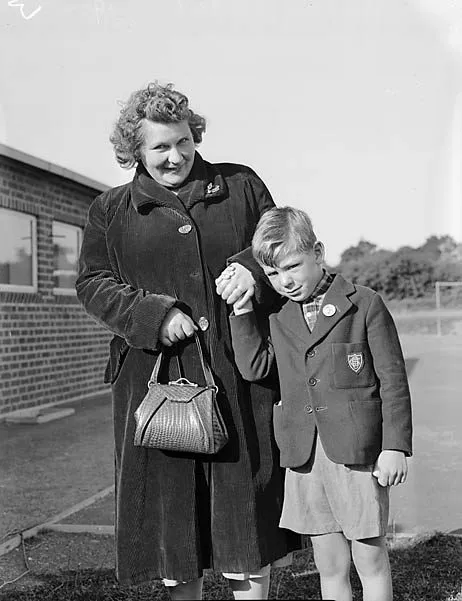
 A 1944 photograph of pupils inside a village school classroom in Cambridgeshire, England.
Credit: UK Ministry of Information Photo Division; public domain, via Wikimedia Commons.
That dynamic is familiar to anyone who has navigated Britain's special educational needs system. As Verity has previously reported, families are finding growing up harder than ever, and young people themselves report that support too often arrives only after a crisis. The review confirms that diagnosis has become the gateway: parents wait years for an assessment because without the label, schools and services cannot — or will not — act. About 800,000 people are currently on NHS waiting lists for ADHD assessments alone.
The tipping point argument
Professor Wessely, one of the country's most prominent psychiatrists, told reporters there had been significant under-diagnosis of ADHD and autism for years — but warned the pendulum may now be swinging too far. As The Sun's coverage of his remarks reports, he described the country as approaching "a kind of tipping point", where the drive to secure labels risks medicalising ordinary difficulty and overlooking what children can actually do. One of the main harms of diagnosis, he suggested, is that it can brand a child as unable to do things they might, with the right support, manage perfectly well.
That concern runs through the review's core recommendation: a shift from a diagnosis-led system to a needs-based one. Children displaying restlessness in class, for example, could receive extra one-to-one support regardless of whether they hold a formal diagnosis of ADHD, autism or anything else — an approach The Times previewed from the review's interim findings, with NHS resources triaged toward those with the highest impairment. Professor Fonagy put it plainly: "Diagnosis remains essential and must be protected — what has to change is that it is no longer the only door through which help can be reached."
It is a deceptively radical proposition. For decades, British special educational needs funding, school adjustments and even benefit entitlements have flowed through the diagnostic label. Removing the label from the centre of the system means rebuilding how support is commissioned, funded and delivered — which is why the review calls for the commissioning, funding, oversight and regulation of mental health and neurodevelopmental services to be overhauled wholesale, not patched.
Schools in the spotlight
The review is blunt about schools. It argues that they are failing some children — not through malice but through a structure that waits for problems to become clinical before intervening. The result is a cruel paradox: the children with the mildest difficulties wait longest, because the system triages by label, and their difficulties escalate while they wait.
The government has pledged that the forthcoming Mental Health Strategy will deliver a renewed focus on prevention and early intervention, with greater support in schools, colleges and communities. Edinburgh Live's report on the response notes ministers have also taken up the review's call to strengthen oversight of assessments, including bringing private ADHD and autism assessment providers under Care Quality Commission regulation. Health Secretary Yvette Cooper said: "It is clear that mental health services need to change to focus more on the early support young people need to stay in education or work or keep their lives on track." NHS leaders have been tasked with examining how people can access advice, assessments and treatment more easily.
The review also identifies the drivers of rising mental distress among young people — social media, financial insecurity, uncertainty about the future, poorer sleep and a reduced sense of connection and belonging. These are societal pressures that no clinic can treat alone, and the authors argue that greater investment in youth services, not just clinical pathways, is part of the answer. For parents trying to make sense of the noise, our earlier piece on trusting your instincts amid parenting advice may offer some perspective.
The campaigners' fear: a review used to deny help
If the review's diagnosis of the system is broadly accepted, its implications are hotly contested. Charities and campaigners fear that talk of over-diagnosis — however carefully qualified — will be weaponised to restrict access to support that families fought hard to secure.
The National Autistic Society's Mel Merritt said the report made clear that "successive governments have failed autistic people", adding that the harm and distress autistic people face is real and widespread and that there is a desperate need for a system built around their needs. The charity's position is that the problem is not too many diagnoses but too little support — and that framing the debate as one of over-diagnosis risks blaming families for seeking help in a system that gave them no alternative.
ADHD UK has been sharper still. Its chief executive, Henry Shelford, has called the NHS's rationing of assessments "scandalous", and the charity has threatened judicial review proceedings against the West Yorkshire integrated care board over its two-year minimum wait. Reporting on the dispute sets out the scale: four boards now impose such minimums, and 15 — covering some 19 million people — have found ways to limit the number of assessments they fund each year, through caps or "clinical prioritisation" that sees only the most severe cases. Corinne Hunter, chief executive of the charity Stripes, said families were not even consulted before the West Yorkshire minimum was introduced: "People often put off seeking an ADHD assessment for years, until they reach the point where they are really struggling to cope. Getting referred can finally feel like there is some light at the end of the tunnel, only to then be told that light could be another two years away."
The mental health charity Mind struck a more conciliatory note. Its chief executive, Dr Sarah Hughes, welcomed the commitment to earlier support, noting that young people are growing up in a challenging world and it is no surprise more are struggling. That welcome, though, came with an implicit condition: earlier support must mean more help, not a quieter route to saying no.
The politics of the label
The review has landed in a febrile political climate. Sickness and disability benefit claims have surged — 4.7 million working-age people now claim disability or incapacity benefits, up 1.8 million, or 62 per cent, since 2019 — and neurodevelopmental conditions have become the most common reason for claims. Conservative work and pensions spokesman Helen Whately argued that too many young people are "defined by their diagnosis, not by what they can achieve", and that the country is "not twice as sick" as it was in 2019.
The government, for its part, insists the review is about better care, not cutting it. Its response pledges broader support and advice earlier, without the wait for a clinical diagnosis, and a major overhaul of how services are organised. Ministers have also taken up the review's recommendation that private providers offering ADHD and autism assessments should be regulated by the Care Quality Commission, with a review of advertising practices — a response to concerns about inconsistent quality and financial incentives in private assessments.
Whether the overhaul materialises is another question. The review itself says incremental fixes will not work, and the NHS winter pressures facing the service this year leave little slack for a root-and-branch rebuild. But the direction of travel is now set: support first, labels second — and a reckoning for a system that made a diagnosis the only door to help.
For readers following Verity's health coverage, this story sits alongside our reporting on teen mental health and AI. You can read more about who we are on our about page, or return to the homepage for the latest news.