Rosie Whitfield thought she knew what she was getting into. Then she had two boys — "two wild boys" — and discovered that modern parenting comes with a soundtrack of expert voices narrating her every move. Every choice felt loaded: "ruining their lives forever" was the fear, and the advice was "overwhelming". Putting the television on for twenty minutes while she did the dishes felt like "choosing to destroy my children's brains". Sending a son upstairs to calm down raised the spectre of attachment disorder. "There isn't the perfect parent," she concluded. She is right, and the fact that she had to say it out loud tells you everything about the culture she was swimming in.
New government research has now put a number on what Rosie felt: around two-thirds of parents with young children say they feel overwhelmed by the sheer volume of parenting information. Not by their children — by the advice about their children. The village it takes to raise a child has been replaced by a content feed, and the feed never sleeps.
Gentle parenting. Helicopter parenting. Snowplough parenting. Tiger parenting. The BBC's InDepth report on the phenomenon poses the question plainly: is there really a best way to raise a child? The market certainly behaves as if there is. Each philosophy arrives with its own vocabulary, its own gurus, its own implicit threat — follow the wrong brand and the damage is on you.
Rosie's testimony captures the psychological mechanism perfectly: the advice "made mundane parenting choices feel like the absolute end of the world". This is not information; it is a moral economy. Twenty minutes of television becomes a referendum on your child's neurology. A boundary becomes a trauma. The parenting internet does not merely inform decisions — it moralises them, then sells you the antidote.
Beneath the brand names sits a genuine academic debate. In the 1960s, developmental psychologist Diana Baumrind identified three parenting styles, later expanded to four: authoritative (warm but firm), authoritarian (firm but cold), permissive (warm but lax) and neglectful. Decades of research have broadly favoured the authoritative style — and that is where the current argument starts.
Matilda Gosling, author of Evidence-Based Parenting, surveyed more than 1,000 studies and came down firmly on one side: "Authoritative is the gold standard." Her critique of the gentle-parenting end of the spectrum is pointed: "It's very much child-led. The child ends up having so much control that there's no sense of safety coming from the outside." She also notes the historical pendulum: "Throughout history, you get these swings from one extreme to the other" — each generation parenting in furious reaction to the last.
Sarah Ockwell-Smith, who popularised "gentle parenting" in Britain, says her philosophy is being traduced by its own imitators. "It [gentle parenting] is not remotely permissive," she insists. The real thing, she argues, has "house rules, family limits, discipline and consequences. But the difference is we look at discipline as learning and teaching rather than punishing." What exhausts her is the social-media distortion: "I have to step away from the Instagram reels and the TikToks because I just want to comment, 'This is not gentle parenting'." Her verdict on the advice deluge is damning: "It's terrible because parents become completely exhausted." And the noise is "deafening and confusing".
Both women are, in their way, making the same complaint: that a nuanced evidence base has been flattened into slogans, and that the slogans are hurting the health and confidence of the people they were meant to help.
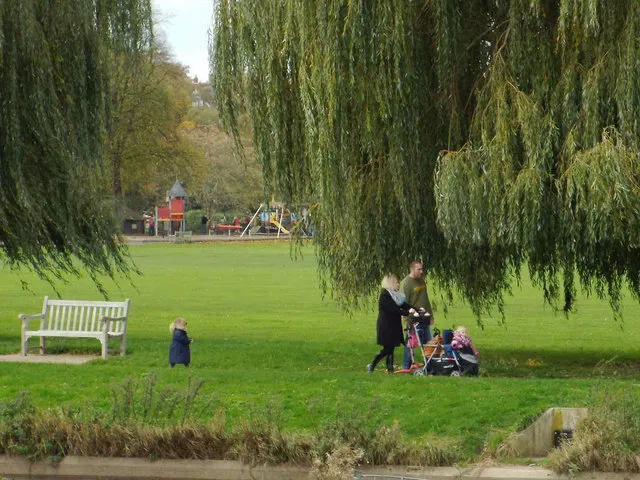
!Families walking together at Combe Abbey parkland
Credit: Robin Stott, CC BY-SA 2.0, via Wikimedia Commons
The advice industry is not new; only its velocity is. Nearly eighty years ago, Dr Benjamin Spock's Baby and Child Care became one of the best-selling books in history by telling parents, radically, to trust themselves. Professor Ellie Lee, director of the Centre for Parenting Culture Studies, notes the irony: "Dr Spock's 'trust yourself' philosophy is now a very counter-cultural piece of advice." What replaced it, she says, is a standing instruction: "What we say instead is 'always seek help'."
The 1990s added policy to the pressure. Governments began treating parenting as a public project — something to be steered, measured and improved — and the expert class moved in permanently. Then came social media, which did to parenting what it did to everything else: collapsed context, rewarded certainty, and turned every mealtime into performable content. The same digital forces changing what creativity means are now reshaping what parenting means. Governments are belatedly pushing back against the feed's harms: Britain has proposed a midnight social media curfew for teenagers, and doctors have warned that vaping could harm children as the UK pushes for tighter controls. A health visitor like Ruth Watts, or a London mother of three like Aymara Lamche-Brennan, now parents in a world where a stranger's reel can reach millions before breakfast.
The market responded with courses. Programmes such as Circle of Security promise to decode the parent-child bond; charities run groups where, as Jennifer Peters — a former social worker who directs the charity Connected Lives — puts it: "It's not telling you how to parent. It's helping you think." Parents in those rooms report the same revelation: "I don't think people need to be bombarded with information but the group experience helps you think, 'oh, it's not just me' and lets you take a step back from it all." The most valued thing the course provides, it turns out, is not information at all. It is permission to exhale.
Here is the uncomfortable truth the parenting industry cannot afford to print on a book jacket: the evidence for any single "best way" is thinner than the marketing suggests, and the confident certainty being sold to parents is the product, not the science.
Consider what we actually know. Baumrind's authoritative style has decades of correlational support — but correlation is not a manual, and "warm but firm" describes a relationship, not a technique. You cannot hashtag a relationship. Gosling's thousand studies are real, and her warning about child-led chaos deserves a hearing. Ockwell-Smith's insistence that gentle parenting includes boundaries is equally serious. What neither can give Rosie Whitfield is the thing she actually needs: someone authoritative enough to tell her that twenty minutes of television while she drinks her coffee is fine.
That is the market failure at the heart of this. Advice is abundant precisely because certainty sells; humility does not. A reel that says "trust yourself, you're doing fine" gets no engagement, builds no brand, sells no course. A reel that says "this common mistake is destroying your child's attachment" gets millions of views — and leaves two-thirds of parents feeling overwhelmed, which the government's own research now confirms.
The policy response is, to its credit, moving in the right direction. The government's Best Start Family Hubs — hundreds now open nationwide, with the Healthy Babies programme being rolled out to every hub and expanded health-visiting support planned across 1,000 hubs — aim to put infant feeding, mental health and parenting support under one roof, rebuilding something like the Sure Start ethos. Charities like Action for Children run parenting programmes and a free Parent Talk advice service for parents who want a human being rather than an algorithm. Demand is real: the charity reports a 51% rise in demand for help with children's violent behaviour toward parents. The need is not in doubt. The question is whether the help on offer calms parents down or winds them up further.
Spock's heresy — trust yourself — remains the most radical advice in the room, precisely because no one can monetise it. The research supports authoritative parenting; it does not support parental self-flagellation. The parents in Jennifer Peters' groups stumbled onto the real insight: "it's not just me" is worth more than a thousand reels. If the parenting industry took its own evidence seriously, it would say less, charge less, and start with the sentence Rosie Whitfield had to discover on her own: there isn't the perfect parent — and there never needed to be.
The government's own finding — two-thirds of parents overwhelmed — is now on the record, which makes it harder for policymakers to keep funding the noise without addressing it. Watch whether the family-hub rollout includes any serious attempt to regulate or counteract the misinformation end of the parenting internet, where Ockwell-Smith herself says the distortions live.
Watch, too, whether the Baumrind debate escapes academia. Gosling's evidence-based broadside and the gentle-parenting backlash are really an argument about what counts as authority in 2026: the peer-reviewed study, the bestselling author, or the mum with two million followers. Parents will keep voting with their attention. The hope — for Rosie Whitfield's sake, and every parent doom-scrolling at 2am — is that the next wave of advice learns the lesson the last one forgot: exhausted parents do not need more instructions. They need fewer, better ones, and the confidence to trust themselves.
*VERITY is an independent digital news platform covering opinion, world news, business and more. Read about our editorial standards.*