Could a Safer Football Help Protect Future Players from Dementia?
Football has always been more than a sport. It brings communities together, supports physical fitness, and inspires millions of people across the world. But alongside its many benefits, scientists are increasingly paying attention to a serious concern: repeated heading of the ball may be linked to long-term brain health problems, including dementia.
A young researcher now believes he may have uncovered an overlooked part of the story that could change how football-related brain injuries are understood.
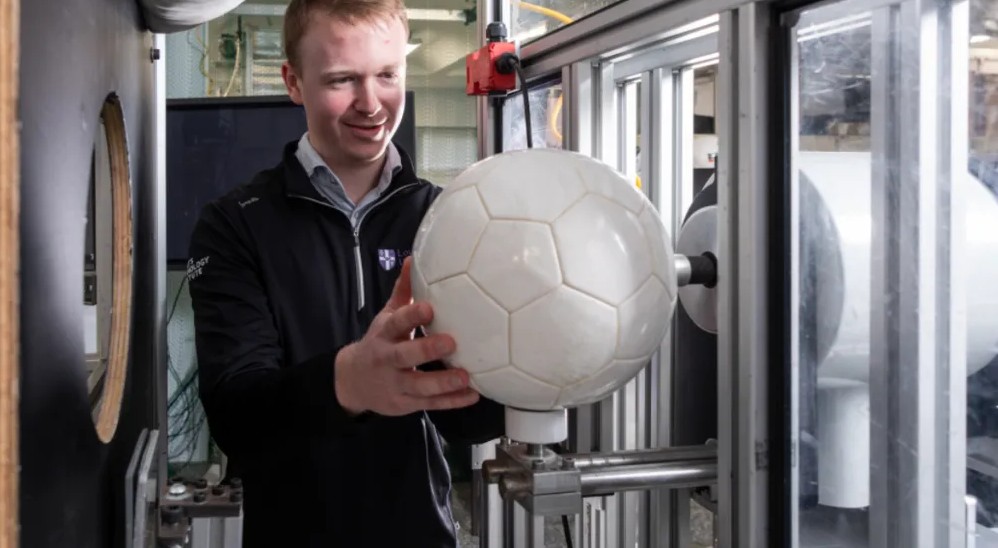
Dr Ieuan Phillips, a sports engineering researcher at Loughborough University, has spent years studying what happens inside the head when a football is headed. Instead of looking only at visible injuries or obvious concussion symptoms, his work focuses on the pressure waves that move through the skull the moment the ball makes contact.
His findings have opened up a new scientific conversation and could eventually influence how footballs are designed, tested, and manufactured in the future.
The project began during the COVID-19 lockdown, when Phillips started reading studies about the higher rates of neurodegenerative disease seen in some former footballers.
Researchers had already shown that repeated heading may be associated with brain health concerns, but one major question remained unanswered.
What exactly is happening inside the brain every time a player heads the ball?
Most earlier studies focused on head movement or concussion-related injuries. Phillips wanted to know whether another force might be affecting the brain even when a player does not feel injured.
That question became the starting point for years of laboratory work aimed at measuring the hidden forces created when a football strikes the head.
Concussions are less common in football than in sports such as boxing, rugby, or American football. Even so, professional players may head the ball thousands of times over the course of their careers in training and matches.
Scientists now believe that these repeated low-level impacts may build up over time.
Phillips’ research suggests that every header creates a brief pressure wave that travels through the skull and into the brain almost instantly.
This happens before the head itself has time to move significantly. In other words, the pressure wave is not the same as the visible motion of the head after impact.
Understanding this process may help explain why some former footballers later develop neurological conditions even if they never suffered a major concussion during their playing careers.
To explore the theory, Phillips and his team carried out laboratory experiments using an advanced head model fitted with pressure sensors.
The researchers fired footballs at the model at different speeds to simulate real match situations, including softer passes, crosses, corners, and powerful shots.
The sensors measured how much energy entered the model skull during each impact.
Rather than focusing only on the force of the collision, the team studied how pressure moved through the head immediately after contact.
This gave researchers a new way to examine football biomechanics, an area that has received far less attention than concussion research.
One of the most unexpected results involved the footballs themselves.
For years, many people assumed that the old leather footballs used in earlier eras were the main cause of long-term brain damage because they could absorb water and become much heavier in wet conditions.
But the laboratory results told a more complicated story.
The team tested around 20 different football designs from different periods in the sport’s history.
Some modern footballs transferred as much, or even more, energy into the test head than older leather balls.
That suggests the issue is not simply about whether a ball is old or new. Instead, the way a football is built appears to matter more than many people previously thought.
Modern footballs often contain several layers, including synthetic outer panels, foam, textile materials, and laminated structures designed to improve durability and performance. Those same design features may also affect how impact energy travels into a player’s head.
The findings are important for sports engineers and equipment manufacturers.
A football can meet all current performance standards and still behave very differently when it comes to heading impact.
If future research confirms these results in real-world conditions, manufacturers may be able to redesign footballs using different internal materials that reduce harmful pressure transmission while keeping the ball’s bounce, speed, and accuracy intact.
That would mean players could continue to enjoy the game while potentially facing a lower long-term neurological risk.
Rather than changing football itself, researchers hope innovation in equipment could become part of the solution.
Scientists are still trying to understand how repeated subconcussive impacts affect the brain.
Unlike severe traumatic brain injuries, these smaller impacts usually do not cause immediate symptoms. Players often continue training or playing without realizing anything is wrong.
However, experts believe that repeated exposure over many years may contribute to microscopic changes in brain tissue.
Previous medical studies involving retired professional footballers have reported higher rates of neurodegenerative disease than in the general population, although researchers are still working to understand exactly why that happens.
Phillips believes pressure-wave research adds another important piece to the puzzle.
His work does not suggest that every header causes brain damage. Instead, it offers scientists a new mechanism to investigate in future medical and sports science studies.
The possibility of a safer football is exciting, but Phillips says more research is needed before any practical changes can be made.
He hopes future studies will examine how these pressure waves affect the brain in real-world settings and whether different ball designs can reduce the force transmitted during heading.
He also wants to see larger-scale testing so that parents, coaches, and players can better understand the risks.
In the long term, the goal is not to remove football from the game, but to make it safer for the next generation.
If researchers and manufacturers can work together, it may be possible to create a ball that protects players without changing the sport people love.
Football is deeply embedded in global culture, and heading is a normal part of the game. That is why this research matters so much.
If a safer football can be developed, it could help reduce the risk of long-term brain injury while preserving the excitement and tradition of the sport.
Phillips’ work is still part of a much larger scientific conversation, but it has already challenged assumptions and opened new possibilities.
For players, parents, coaches, and governing bodies, the message is clear: football safety should continue to evolve as science advances.
Learn More