The White House has suspended Microsoft from the federal programme that allows companies to sponsor foreign workers for permanent US residency, escalating the Trump administration's crackdown on employment-based immigration. The announcement came from Vice-President JD Vance at a Thursday press conference, where he accused the technology giant of systematically abusing the system while cutting American jobs.
The move bars Microsoft from the Permanent Labor Certification programme, known as PERM, which is the standard route employers use to move workers from temporary H-1B visas to green cards. The suspension covers both new applications and those already pending, meaning thousands of Microsoft employees in the sponsorship pipeline now face an uncertain path to permanent residency.
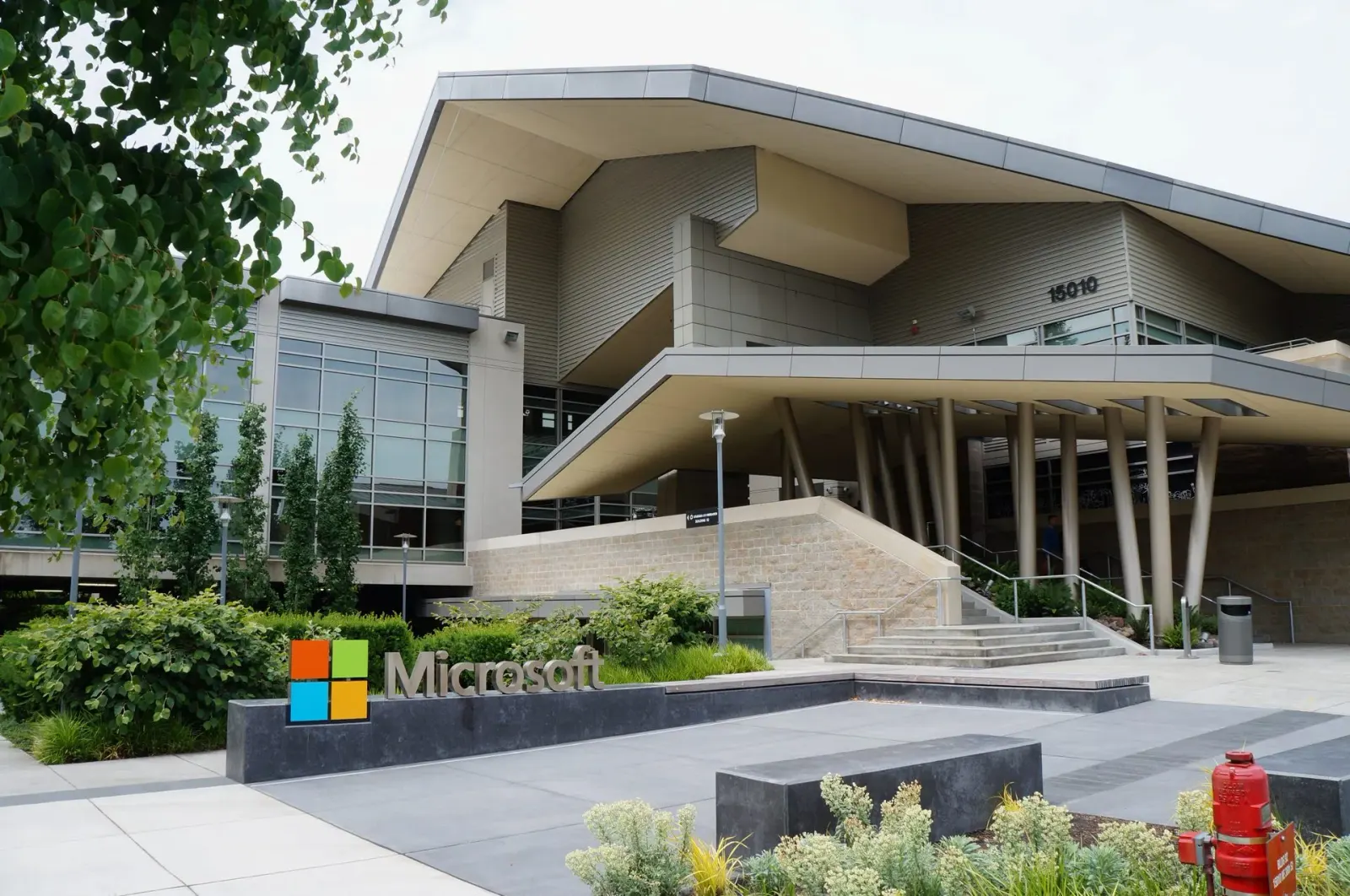 Building 92 on Microsoft's corporate campus in Redmond, Washington
Credit: Jiaqian via Wikimedia Commons (CC BY 3.0)
What the administration announced
Vance unveiled the action alongside Labor Secretary Keith Sonderling, Attorney General Todd Blanche and White House deputy chief of staff Stephen Miller at a press conference in the Eisenhower Executive Office Building, held under the banner of the administration's anti-fraud task force. Sonderling said the Department of Labor would no longer accept or process any permanent labour certification applications involving Microsoft, Adobe, and six major IT outsourcing firms: Cognizant, Infosys, Tata, Wipro, HCL and Capgemini.
The suspension, he said, followed ongoing criminal investigations led by the Department of Labor's inspector general, and he described the move as a historic effort to shut down systemic fraud in the programme, according to USA Today.
Sonderling said the eight companies had collectively requested nearly three million foreign workers since 2009, receiving more than 230,000 H-1B visa approvals and over 100,000 permanent labour certifications. The administration did not release company-specific findings or details of the alleged violations at the press conference. The step marks one of the most aggressive uses of administrative power against the technology sector's hiring practices in recent memory, and it lands squarely in the Business crosshairs of investors watching Microsoft's labour costs.
Vance's accusations against Microsoft
The vice-president directed his sharpest criticism at Microsoft, accusing the company of using foreign workers to displace American employees. He said the company laid off roughly 6,000 American workers in 2025 while being approved for about 6,000 H-1B visas and filing 3,682 PERM applications, nearly 1,000 of them for the same positions as the workers it had let go.
"Our message to Microsoft is: You're a great American company, but you've got to hire great American workers," Vance told reporters. "You cannot lay off American workers and then replace them with foreign indentured servants." He argued that the arithmetic showed the company replacing every laid-off worker with roughly one and a half foreign workers.
Critics of the H-1B programme have long argued it is overused, lets employers hire cheaper foreign labour instead of Americans, and is rife with abuse — a view shared by prominent figures in the administration's political movement. The remarks did not establish that each visa or green card represented a new hire replacing a laid-off worker, and the White House did not say how long the suspension would remain in place. The confrontation adds a new dimension to a technology industry already rattled by layoffs and restructuring, as analysts debate the health of the American jobs market.
The PERM programme, explained
PERM is the foundation of most employment-based green cards in the United States. Before sponsoring a foreign worker for permanent residency, an employer must obtain a permanent labour certification from the Department of Labor — a process that requires demonstrating, through recruitment advertising and wage documentation, that no qualified American worker is available for the position.
Only after certification can the employer petition US Citizenship and Immigration Services for the worker's green card. Because annual green-card quotas are tight, particularly for workers from India and China, the PERM queue can stretch for years. For technology companies, the programme is the main legal bridge between the temporary H-1B skilled-worker visa — capped at 85,000 new visas a year — and permanent employment of foreign staff.
By freezing Microsoft's and the outsourcing firms' access to that bridge, the administration has effectively halted their ability to convert current foreign employees into permanent residents, a benefit many workers weigh heavily when choosing employers. Immigration lawyers say the freeze could also push affected workers toward rival firms that retain PERM access. More background on the federal immigration framework is available through US Citizenship and Immigration Services.
Microsoft's response
Microsoft pushed back against the accusations, saying the "vast majority" of its US employees are Americans. The company said that of roughly 6,000 H-1B visa applications in the past fiscal year, 80% were to "extend or change the status" of existing workers rather than to bring in new arrivals — a figure that directly contests the administration's portrayal of the company as importing replacement labour.
"We believe in the strength and talent of the American workforce," the company said in a statement, according to the New York Post.
The company has not commented in detail on the specific allegations of fraud or on the federal investigations cited by Sonderling. With some 223,000 employees worldwide and its headquarters in Redmond, Washington, Microsoft is among the largest H-1B employers in the country, though its petition volumes trail Amazon and other heavy users of the skilled-worker visa. Legal analysts expect the company to challenge the suspension in court, arguing that a blanket freeze without published findings exceeds the Labor Department's authority.
Praise and pressure on the same day
The crackdown produced a striking split-screen: hours before Vance's press conference, President Trump was awarding Microsoft chief executive Satya Nadella one of the nation's highest honours. At the "Science: A New Golden Age" summit, Trump presented Nadella with the National Medal of Technology and Innovation, alongside Dell Technologies founder Michael Dell. The National Medal of Science went to Elon Musk, Google co-founder Sergey Brin, Nvidia chief Jensen Huang and AMD chief Lisa Su.
Trump singled out Nadella for transforming Microsoft into a global technology powerhouse and positioning it at the forefront of artificial intelligence, describing the recipients as national treasures pioneering a new era for American innovation, according to Gulf News.
Vance acknowledged the tension, saying the administration did not intend to harm Microsoft but wanted to pressure it to prioritise American workers while continuing to support the broader relationship. The contrast highlighted the administration's two-track approach: celebrating the technology industry's achievements while policing its hiring, as also seen in the Pentagon's recent blacklisting of an AI provider. Details of the ceremony were reported by The Hindu BusinessLine.
A wider crackdown beyond tech
The PERM suspensions were only one element of a broader offensive. Vance also called for scrutiny of nine universities over their use of foreign researchers and student visas, reviving the administration's feud with elite institutions that have faced pressure since Trump returned to office. Universities including Harvard, Yale and Stanford were named in coverage of the crackdown, with officials accusing some institutions of operating as visa mills.
Sonderling framed the day's actions as the start of a campaign to protect American white-collar workers, arguing that universities and companies acting as visa mills had promoted foreign workers who misrepresented their qualifications to take American jobs. The outsourcing firms named — Cognizant, Infosys, Tata, Wipro, HCL and Capgemini — have long been among the heaviest users of the H-1B system. The original BBC report on the Microsoft suspension is here.
What happens next
The immediate question is how the freeze will be implemented and whether it will survive legal challenge. The administration has not specified how pending PERM applications from the eight companies will be treated, nor whether the suspension has a defined end date. Microsoft and the other firms could seek emergency court orders to keep their applications moving while the underlying fraud investigations play out.
Longer term, the action signals that the White House intends to use immigration enforcement as a lever over corporate hiring far beyond the technology sector's traditional flashpoints. With midterm elections approaching, the administration appears to be betting that a hard line on white-collar immigration will resonate with voters — even as it risks disrupting the talent pipelines of some of America's most valuable companies. For more on the administration's posture, see Verity's Politics coverage and the homepage for developing stories.