The long-running trade dispute between the United States and Canada continues to affect businesses and workers across North America.
Since President Donald Trump returned to the White House and introduced a broad tariff programme, Canada has faced US duties targeting important industries including steel, aluminium, lumber and automobiles.
Canada has responded with its own tariffs on selected American products.
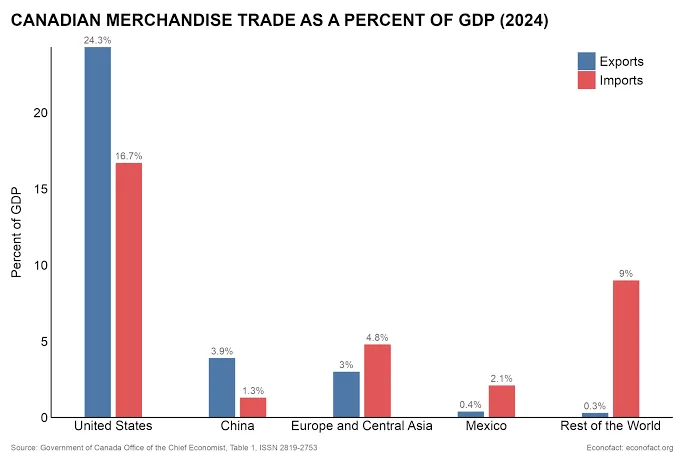
The economic relationship between the two countries is particularly important because the US is Canada's dominant export market. More than 70% of Canadian exports go to the United States, making the trade conflict especially significant for Canadian businesses.
Here are five key economic trends that illustrate the impact of the dispute.
The impact of US tariffs has not been evenly distributed across Canada.
Ontario, the country's most populous province and a major manufacturing centre, has been particularly exposed because of its large automotive and steel industries.
Several auto parts suppliers and vehicle manufacturing facilities in the province have announced production reductions or layoffs amid uncertainty surrounding cross-border trade.
Quebec has also experienced pressure, particularly in its metals industry. Data released in July showed that metal exports from the province fell by about 36% between February 2025 and February 2026, while employment in the sector declined by around 3.6%.
Other provinces, including Alberta, Saskatchewan, New Brunswick, Newfoundland and Labrador and Prince Edward Island, have been considered less exposed to the US sectoral tariffs.
However, the broader effects of the trade dispute are expected to reach businesses across Canada as additional tariffs take effect.
Canada's response is also affecting American exporters.
Canadian authorities have introduced counter-tariffs covering billions of dollars worth of US products, including goods such as steel, furniture, cosmetics and household products.
The impact varies considerably between US states.
Ohio is among the states most exposed to Canada's retaliatory measures, with billions of dollars of exports potentially subject to tariffs.
Illinois and Pennsylvania are also facing significant exposure.
For Ohio, steel products and washing machines are among the affected goods. Illinois faces pressure on exports of agricultural and construction machinery.
Economists have suggested that Canada's tariff strategy may have been designed partly around politically important US states, potentially increasing pressure on industries in regions that could play a significant role in future US elections.
For much of the trade dispute, Canada maintained a relatively low average effective tariff rate compared with several other major US trading partners.
That advantage has narrowed following the introduction of additional US duties.
According to figures cited from the Royal Bank of Canada, Canada's average effective US tariff rate stood at about 2.9% in June.
It has since increased to approximately 5.7%.
For comparison, the effective US tariff rate on imports from the UK was around 6.2%, while China's average rate remained considerably higher at approximately 20.5%.
The change illustrates how Canada's position in the US tariff system has shifted as Washington has expanded duties on Canadian products.
The trade dispute has also encouraged Canadian companies to look beyond the United States.
Canada's economy has traditionally depended heavily on its southern neighbour because of geographical proximity and decades of trade agreements.
But businesses are now exploring opportunities in Europe, Asia and other markets.
Canadian Prime Minister Mark Carney has pledged to increase the country's exports outside the US, with a goal of doubling non-US exports over the next decade.
Some Canadian companies are already changing their strategies.
Businesses that once focused heavily on the US market are exploring European trade shows and developing relationships with buyers outside North America.
However, diversification is considerably harder for industries whose supply chains are deeply connected to the United States.
Manufacturing centres in Ontario, including Oshawa, London and the Kitchener-Cambridge-Waterloo region, remain particularly vulnerable because of their strong links to American customers and suppliers.
Despite the trade uncertainty, Canada's economy has shown some resilience.
Foreign direct investment reached approximately C$96.8 billion in 2025, the highest annual inflow since 2007.
Canada's GDP also grew by 3.3% in the second quarter of 2026, supported by stronger exports and domestic investment.
The effects of the trade war are also being felt in employment.
Around 55,000 manufacturing jobs were lost in Canada between January 2025 and January 2026, according to Bank of Canada data cited in the report.
Economist Trevor Tombe has estimated that Canada's job losses could reach approximately 90,000 if the latest US tariffs remain in place.
The United States has also experienced employment pressures in industries connected to manufacturing, transportation and warehousing as tariffs reshape trade flows and production costs.
Consumers can also feel the effects through higher prices.
Tariffs increase the cost of imported products and materials, and businesses may pass some of those additional expenses on to customers.
The US-based Tax Foundation has estimated that American households could face hundreds of dollars in additional annual costs as a result of the wider tariff programme.
Canada's retaliatory tariffs have been more targeted toward limiting the direct impact on consumers, although Canadian manufacturers could still face higher production costs when imported US industrial materials become more expensive.
The future of the US-Canada trade relationship remains uncertain.
One of the biggest concerns for businesses is the future of the USMCA, the North American trade agreement linking the United States, Canada and Mexico.
A prolonged trade dispute could encourage companies to reconsider supply chains, investment decisions and export markets.
Canada is increasingly looking to strengthen trade relationships outside the US, while American industries that depend on Canadian materials and customers are also facing pressure from the escalating dispute.
The two countries remain deeply economically connected, meaning tariffs on one side can quickly create consequences on the other.
For now, businesses are adapting to higher trade costs while governments continue to negotiate and defend their respective economic interests.
The five economic indicators show that the trade war is no longer simply a dispute over tariffs. It is influencing where companies invest, where products are sold, where jobs are created, and how much consumers pay.