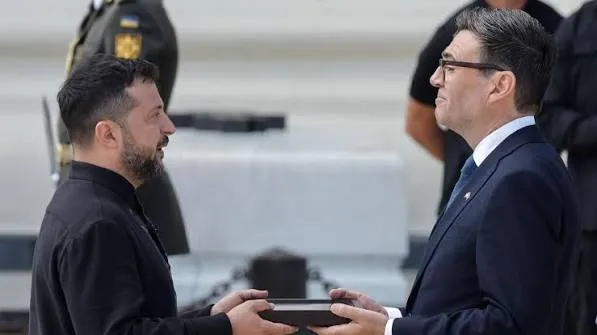
In a significant declaration underscoring the unwavering commitment of the United Kingdom to its allies, Prime Minister Burnham has publicly vowed continued, robust support for Ukraine. This resolute stance comes despite what he termed 'outrageous threats' emanating from Moscow, which has warned of severe 'consequences' following reports of Ukrainian forces utilizing British-supplied drones in the ongoing conflict.
The Prime Minister's declaration not only reaffirms the UK's strategic alignment with Kyiv but also highlights the escalating rhetorical and geopolitical tensions between Russia and Western nations, particularly concerning the nature and extent of military aid provided to Ukraine. This incident is a critical flashpoint, illustrating the precarious balance of international diplomacy and the enduring resolve of sovereign nations to uphold principles of territorial integrity and self-defense against aggression.
Prime Minister Burnham's recent statement reverberates across global capitals, signaling a clear and unambiguous message: the United Kingdom will not be deterred by Russian intimidation tactics. His characterization of Moscow's warnings as 'outrageous threats' underscores a deep-seated rejection of what is perceived as an attempt to dictate the sovereign foreign policy decisions of the UK and its allies. This firm declaration arrives at a pivotal moment in the protracted conflict in Eastern Europe, where the efficacy of Western military assistance continues to play a crucial role in Ukraine's defense.
The UK has consistently been at the forefront of international efforts to bolster Ukraine's defensive capabilities, providing substantial financial, humanitarian, and military aid since the full-scale invasion commenced. Prime Minister Burnham’s affirmation is not merely a reiteration of existing policy but a defiant response to specific, recent provocations. It solidifies the UK's position as a stalwart supporter of the rules-based international order and a key advocate for Ukraine's right to self-determination. The commitment extends beyond mere rhetoric, encompassing a steady flow of various forms of assistance, from advanced weaponry to critical intelligence sharing, all designed to enable Ukraine to resist aggression and reclaim its sovereign territory.
This steadfastness is rooted in a broader geopolitical strategy that recognizes the far-reaching implications of Russian aggression. The UK, alongside its NATO and G7 partners, views the conflict not just as a regional dispute but as a direct challenge to fundamental principles of international law and the security architecture of Europe. Therefore, any perceived attempt by Russia to curtail the legitimate provision of aid to a sovereign nation under attack is met with strong condemnation and an unwavering commitment to continue support. The Prime Minister's resolve serves as a powerful signal to both allies and adversaries alike, emphasizing that the UK's dedication to supporting Ukraine against external coercion remains unshakeable, even in the face of increasingly aggressive diplomatic and military posturing from the Kremlin.
The immediate catalyst for Prime Minister Burnham's robust declaration was a stark warning from Moscow, threatening unspecified but severe 'consequences' over the reported deployment of British drones by Ukrainian forces. This specific accusation marks a notable escalation in Russia's rhetoric, moving beyond general condemnations of Western aid to pinpoint particular assets and their alleged operational use. While the precise nature of these 'British drones' remains undisclosed in the reports, their mention highlights the evolving dynamics of modern warfare, where unmanned aerial vehicles (UAVs) have become indispensable tools for both surveillance and direct engagement.
The strategic importance of drones in the current conflict cannot be overstated. From reconnaissance and targeting to delivering precision strikes and even acting as kamikaze munitions, UAVs offer a relatively low-cost, high-impact capability that has reshaped battlefield tactics. For Russia, the reported use of British-supplied drones likely represents several points of concern. Firstly, it indicates a continued flow of advanced Western technology to Ukraine, enhancing its ability to counter Russian forces. Secondly, it could be interpreted by Moscow as a direct involvement of a NATO member state in offensive operations, blurring the lines of proxy warfare. Lastly, the effectiveness of such drones poses a significant threat to Russian ground forces and infrastructure, prompting a forceful reaction.
Moscow's warning of 'consequences' is deliberately vague, a tactic often employed to maximize psychological impact and maintain strategic ambiguity. Historically, such threats from Russia could encompass a range of retaliatory measures, from heightened diplomatic pressure and cyberattacks to economic sanctions or even direct military action against supply lines or assets perceived to be supporting Ukraine. The specific reference to British drones suggests Russia may be attempting to deter future transfers of similar advanced military equipment, or to raise the political cost for nations providing such aid. This move is part of a broader pattern of Russian attempts to intimidate Western nations, aiming to fracture international unity and diminish support for Ukraine by escalating the perceived risks of involvement. The UK's response, through Prime Minister Burnham, indicates a clear refusal to yield to such pressure, setting the stage for continued friction.
The current exchange of warnings and vows of support is deeply embedded in a longer history of escalating tensions and the consistent provision of Western military aid to Ukraine, particularly since the 2014 annexation of Crimea and the subsequent full-scale invasion in February 2022. From the outset, the United Kingdom has been a leading donor of military assistance, evolving its contributions from defensive equipment and training to more advanced offensive capabilities as the conflict progressed. This trajectory mirrors that of many Western allies, who initially provided non-lethal aid before gradually supplying increasingly sophisticated weaponry, including anti-tank missiles, air defense systems, and now, potentially, advanced drone technology.
Russia has consistently condemned this Western support, characterizing it as an unwarranted interference in its 'special military operation' and a direct threat to its security interests. Moscow has repeatedly issued warnings of 'red lines' that, if crossed by Western arms deliveries, would invite severe retaliation. However, these 'red lines' have often proven to be fluid, with Western nations gradually increasing their aid packages in response to Ukraine's battlefield needs, often without triggering the dire consequences Russia frequently threatened. The provision of advanced Western weaponry has been crucial in enabling Ukraine to withstand the initial onslaught and launch counter-offensives, demonstrating the tangible impact of international solidarity.
This historical pattern highlights a strategic dilemma for both sides. For Western nations, the challenge lies in providing sufficient aid to enable Ukraine to defend itself without provoking a direct, wider conflict with Russia. For Russia, the repeated failure of its 'red line' warnings to deter Western support has been a source of frustration, leading to an intensification of threats and a search for new pressure points. The current focus on British drones represents a specific attempt by Moscow to isolate and target a particular form of aid, potentially to test the resolve of individual nations or to create fissures within the allied coalition. The UK's firm response, however, indicates a continued commitment to the principle that a sovereign nation has the right to receive assistance in its defense, irrespective of threats from an aggressor. This ongoing dynamic underscores the complex and perilous nature of the geopolitical landscape, where every delivery of aid and every rhetorical exchange carries significant weight for international stability and the future of European security.
Prime Minister Burnham's defiant stance and Russia's escalating threats send significant ripples across the global geopolitical landscape, impacting international relations, alliance dynamics, and the broader debate on international law. The exchange underscores the deepening chasm between Russia and Western powers, transforming the conflict in Ukraine into a crucible for the future of the rules-based international order. For NATO, the UK's unwavering commitment reinforces the alliance's collective resolve and deterrence posture, particularly on its eastern flank. It signals that individual members will not be intimidated into abandoning their support for Ukraine, thus strengthening the alliance's unity in the face of Russian aggression. However, it also subtly raises questions about the threshold of escalation and the potential for a miscalculation that could draw NATO more directly into the conflict.
Internationally, the incident reignites discussions about the legality and implications of providing military aid to a nation under attack. Under international law, states have the right to individual and collective self-defense, which includes receiving assistance from other nations. Russia's threats, therefore, are viewed by many as an attempt to undermine these fundamental principles and challenge the sovereignty of nations to make their own foreign policy decisions. This narrative is crucial for countries seeking to maintain global stability and prevent future acts of aggression. The long-term implications for diplomatic engagement are also significant; the hardening of positions on both sides makes de-escalation and negotiation increasingly difficult, pushing the prospect of a lasting peace further out of reach. and other international bodies continue to call for peaceful resolutions, but the current climate is one of entrenched positions.
Furthermore, the focus on drones highlights the ongoing technological arms race and its impact on modern warfare. As nations increasingly rely on advanced, autonomous, or semi-autonomous systems, the ethical and strategic implications become more profound. Russia's strong reaction to British drones could also be an attempt to test the international community's boundaries regarding the types of weaponry deemed acceptable for transfer, particularly those with advanced capabilities that could alter battlefield dynamics significantly. The global impact extends to economic spheres as well; increased geopolitical instability can lead to volatility in energy markets, disruption of supply chains, and a chilling effect on international trade and investment. The unwavering stance of leaders like Prime Minister Burnham, while demonstrating resolve, also signals a prolonged period of elevated international tension, reshaping alliances and redefining the parameters of global security for years to come.
As Prime Minister Burnham unequivocally pledges sustained support for Ukraine, the path ahead is marked by both steadfast resolve and persistent challenges. The UK's commitment, reinforced by this latest declaration, suggests that future aid packages will likely continue to include advanced military equipment, potentially expanding to meet Ukraine's evolving needs on the battlefield. This could encompass more sophisticated long-range precision weapons, enhanced air defense systems, and continued provision of crucial intelligence and training. The strategic rationale behind this approach is clear: to ensure Ukraine possesses the necessary capabilities to defend its territory, degrade Russian military capacity, and ultimately secure a just and lasting peace.
However, the continuation of such robust support is not without its complexities. Russia's warnings of 'consequences' cannot be entirely dismissed, as Moscow has shown a willingness to employ a range of asymmetric tactics, including cyberattacks, disinformation campaigns, and targeted diplomatic pressure, against nations it perceives as hostile. While a direct military confrontation with the UK or other NATO members remains a scenario all parties seek to avoid, the risk of escalation through proxy means or unintended incidents continues to loom large. The international community, therefore, remains in a delicate balancing act, providing essential aid while striving to prevent a broader conflict that could have catastrophic global repercussions.
The long-term implications of this dynamic extend to the future of European security architecture. The conflict has irrevocably altered the geopolitical landscape, necessitating a re-evaluation of defense strategies and alliances. Prime Minister Burnham's stance reinforces the notion that collective security and mutual defense remain paramount in an era of renewed great power competition. The unwavering support for Ukraine, despite 'outrageous threats,' is a testament to the belief that upholding international law and defending sovereign nations against aggression is a collective responsibility. The challenge now lies in maintaining this unity and resolve over the long haul, navigating the intricate web of diplomatic, military, and economic pressures, and ultimately contributing to a secure and stable future for Europe and beyond. The future of European security will undoubtedly be shaped by these ongoing decisions and commitments.