In Short (TL;DR)- BBC FOI requests found just 705 patients had received Mounjaro or Wegovy for weight loss on the NHS in Scotland by September 2026.
- Fewer than half of Scotland's 14 health boards offer the jabs for weight loss, and only through small pilot schemes.
- Mounjaro was approved for NHS weight-loss use in Scotland in 2023 and Wegovy in 2024, yet rollout remains minimal.
- An estimated 300,000 Scots access the drugs privately, creating what doctors describe as a two-tier system.
- Leading clinicians call the slow rollout problematic and discriminatory against people living with obesity.
Scotland approved weight-loss injections for NHS use years ago. Yet new figures show that almost nobody is actually getting them.
Freedom of Information requests submitted by the BBC to health boards across Scotland found that just 705 patients had received Mounjaro or Wegovy specifically for weight loss on the NHS by September 2026 — fewer than 800 people in the entire country. The Glasgow Times, which reported the findings, noted that the tiny number stands in stark contrast to the surging popularity of the treatments: an estimated 300,000 Scots are using the same drugs through private prescriptions, and around 2.4 million people across the UK are thought to be on weight-loss medication.
The figures expose a gap between policy and practice that senior doctors say is becoming indefensible. Mounjaro was cleared for NHS weight-loss use in Scotland back in 2023 — making Scotland the first UK nation to back the drug for obesity — and Wegovy followed in 2024. The Scottish Medicines Consortium, which decides which medicines the NHS in Scotland should fund, has judged these drugs safe and effective. But three years after the first approval, access remains confined to a patchwork of small pilots.
Fewer than half of Scotland's 14 health boards currently offer the injections for weight loss at all, and those that do run only limited pilot schemes. The BBC's investigation identified the participating boards as NHS Forth Valley, NHS Borders, NHS Lothian, NHS Lanarkshire and NHS Western Isles, plus the NHS State Hospital. Everywhere else, patients cannot get the drugs for weight loss through the NHS, although some boards say they are exploring future access.
Eligibility within the pilots is narrow. In NHS Forth Valley, for example, participants typically need a body mass index of 40 or above alongside multiple serious medical conditions, or be facing surgery where weight loss is medically necessary. One pilot patient reported losing four stone since starting treatment, alongside broader improvements in health — a reminder of what is at stake for those locked out.
The structure of the NHS in Scotland helps explain the fragmentation. The Scottish Government has said the medicines form part of a range of obesity treatments, but decisions on availability rest with individual health boards. That devolution of responsibility has produced wildly different outcomes depending on where a patient lives — a postcode lottery for some of the most effective obesity treatments medicine has ever produced.
The contrast between national approval and local delivery is striking. The Scottish Medicines Consortium cleared Mounjaro (tirzepatide) for weight loss and weight maintenance in adults with a BMI of 30 or more plus at least one weight-related condition such as pre-diabetes, high blood pressure or high cholesterol, as pharmaphorum reported. Wegovy (semaglutide) and liraglutide (Saxenda) have also been approved for obesity management, and all three were added to the East Region Formulary in February 2025.
Yet approval has not translated into appointments. NHS Lothian and NHS Lanarkshire — two of the country's largest boards — are currently unable to accept new referrals for the treatments while working groups develop the clinical pathways needed for safe prescribing and monitoring, according to detailed reporting on the rollout. In Lanarkshire, Wegovy and Mounjaro are prescribed only in exceptional circumstances through a specialist weight management service, and GPs do not issue them at all. Across these regions, patients must be managed through specialist services rather than their family doctor, and those services are still being built.
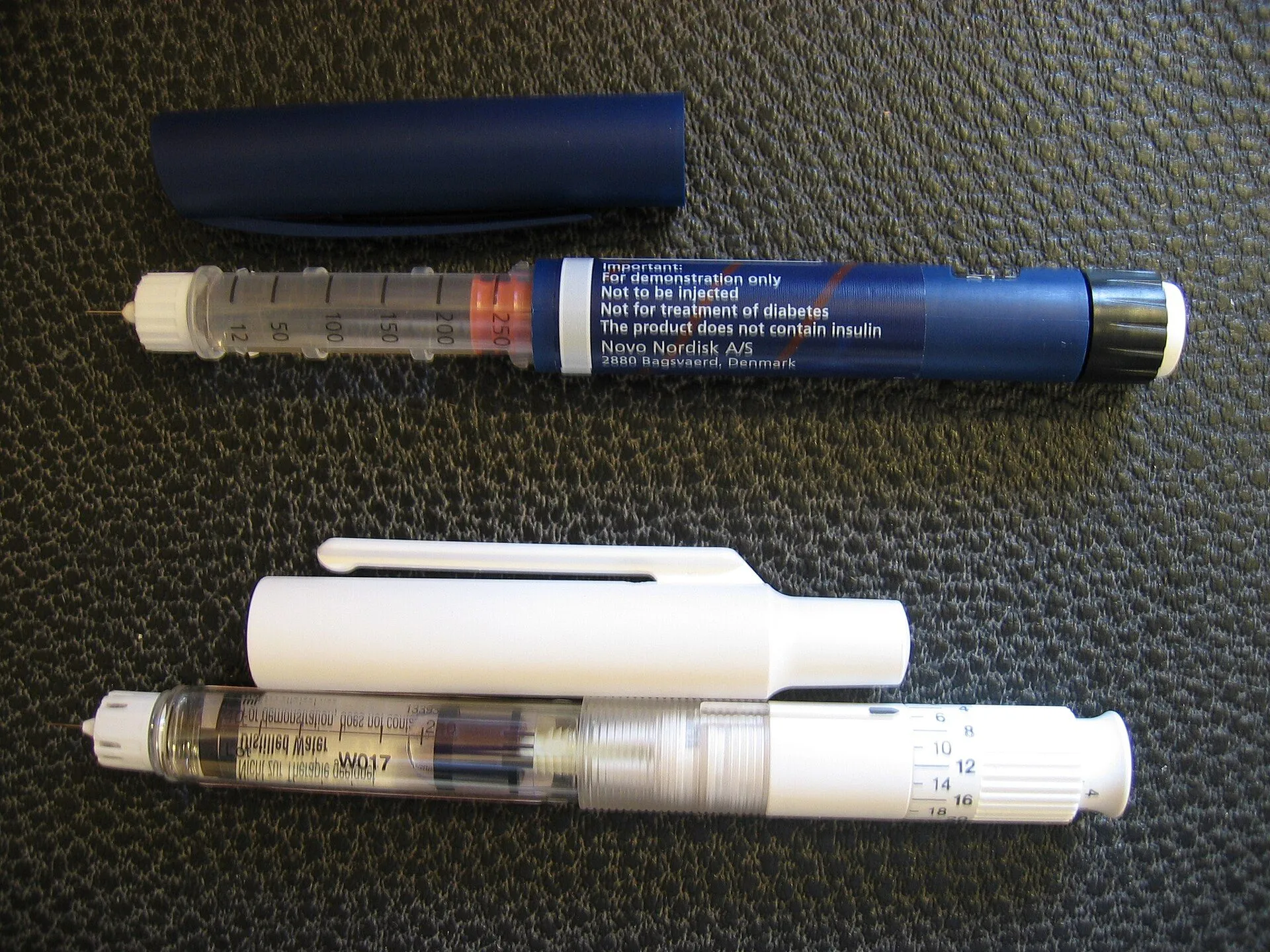
Medical illustration of an insulin syringe, injection pen and medicine vial
Credit: BruceBlaus / Wikimedia Commons, CC BY 3.0
Supply has been another constraint. Global shortages of the drugs have limited how much the NHS can reliably obtain, and boards have had to prioritise the patients with the highest clinical need. But critics argue that caution has hardened into inertia: years after approval, the infrastructure for delivery is still described as being "developed", while demand — and the private market — races ahead.
The consequence is a two-tier system. Those who can afford private prescriptions — often hundreds of pounds a month — can access the drugs now; those who cannot must wait for pilot schemes that may never reach them. Around a third of people in Scotland are classified as obese, and obesity-related illness drives a heavy burden of type 2 diabetes, heart disease and joint problems across the country's health services.
Senior clinicians are increasingly blunt about what that means. Dr Mark Strachan, president of the Royal College of Physicians, has described the situation as problematic, arguing that the lack of meaningful progress represents an opportunity cost: the NHS spends vast sums treating the complications of obesity rather than investing in prevention. He has pointed out that the drugs have been shown to be safe and cost-effective when targeted at high-risk patients. Other doctors have gone further, describing the restricted access as discriminatory against people living with obesity and warning that it widens health inequalities — a charge echoed in analysis of the findings.
The charge stings because the evidence base keeps growing. The drugs, known as GLP-1 receptor agonists, work by suppressing appetite and helping people feel fuller sooner, and they have transformed the medical approach to obesity in the space of a few years. This summer the Scottish Medicines Consortium went further still, accepting semaglutide for reducing cardiovascular risk in adults with established heart disease who are overweight or obese — a decision supported by the 17,604-patient SELECT trial, which found a 20 per cent relative reduction in major cardiovascular events, as Medscape reported. Each expansion of the evidence makes the delivery gap harder to defend.
Health boards point to genuine operational hurdles. The injections are not simple prescriptions: patients need careful dose escalation, monitoring for side effects — most commonly gastrointestinal — and ongoing dietary and lifestyle support, typically involving pharmacists and dietitians. Prescribing them safely at scale means building new clinics, training staff and writing eligibility rules that can survive scrutiny over fairness and cost.
There is also the question of money. Wegovy's UK list price runs to £1,926 for the first year of treatment and £2,285 in subsequent years, before confidential NHS discounts — a serious commitment for boards already under financial pressure, even if the long-term savings from avoided heart attacks, diabetes and joint replacements are real. And because the drugs were first used for type 2 diabetes, boards have had to disentangle weight-loss prescribing from diabetes prescribing in their budgets and formularies.
None of that explains, in the eyes of critics, why a country that led the UK in approving the drugs now trails so far in delivering them. The Scottish Government's consensus statement on national eligibility criteria and phased implementation was supposed to coordinate the rollout; instead, each board has moved at its own pace, and several have effectively paused.
Pressure for change is building from two directions. Clinicians want the pilots scaled into routine services, with clear national eligibility rules so that access does not depend on a patient's postcode. Patient organisations argue that fair access to effective treatment is vital for quality of life — and note that the potential population who could benefit in Scotland runs into the hundreds of thousands.
The private market, meanwhile, will keep growing in the vacuum. Every month that NHS provision stays at pilot scale, more patients who can pay will go private, and the inequality at the heart of the BBC's figures will deepen. For a health service founded on the principle of care based on need rather than ability to pay, 705 patients in three years is a number that invites uncomfortable questions — about funding, about priorities, and about whether Scotland's early lead on approval will count for anything if the jabs never reach the people who need them.
For readers following UK health policy, the story is a reminder that approving a medicine and delivering it are two very different things — as debates over NHS mental health provision, regional health service mergers and emerging threats like wildfire smoke continue to show. You can read more about our mission on the about page or start from the homepage.