In Short (TL;DR)Spanish Prime Minister Pedro Sánchez has called a snap general election for 29 November, more than six months early, after parliament rejected two emergency decree laws aimed at tackling the country's housing crisis. The vote was called on Monday in a televised address, following weekend protests that saw tens of thousands march in Madrid, Valencia and Barcelona. The trigger for the demonstrations was the eviction of 87-year-old Madrid pensioner Maricarmen Abascal, whose rent was raised from €500 to €2,650. Opinion polls currently favour the conservative People's Party, making the snap poll a major political gamble for the Socialist leader.
Spanish Prime Minister Pedro Sánchez has called a snap general election for 29 November, cutting short a parliamentary term that was not due to end until 2027 and throwing one of Europe's largest democracies into a short, sharp campaign defined by a single explosive issue: housing.
The announcement came on Monday in a televised address from Moncloa, the prime minister's official residence in Madrid, after what the government described as a weekend of reflection. "After informing the head of state, I have decided to convene an extraordinary meeting of the Council of Ministers this morning to dissolve parliament and call a general election," Sánchez said, invoking his constitutional prerogative.
The timing was driven by a humiliating defeat in Congress on Friday, when lawmakers voted down two emergency decree laws that Sánchez had designed as his government's answer to the housing emergency gripping the country. If the timetable proceeds as expected, the dissolution decree will be published on Tuesday, triggering the 54-day campaign period required by electoral law and landing the vote on the last Sunday of November.
Few in Spanish politics had predicted the move, yet in hindsight the signs were everywhere: a minority government unable to pass a budget for years, a parliament where every vote was a negotiation, and streets filling with protesters demanding action on the cost of living.
The crisis that broke Sánchez's government began with the story of one woman. Maricarmen Abascal, known across Spain simply as Maricarmen, is 87 years old and had lived in the same apartment in Madrid's Retiro neighbourhood for more than 70 years. Last month she was evicted after an international investment fund bought her building and raised her monthly rent from €500 to €2,650 — an increase of more than five times, and a sum utterly beyond the reach of a pensioner.
Her case, first reported widely in the Spanish press and picked up by international outlets including Reuters, became an overnight symbol of what protesters call the ruthlessness of the Spanish housing market. Within days, hundreds of activists had pitched tents in Madrid's central Puerta del Sol, camping outside the offices of the Madrid regional government to demand emergency action.
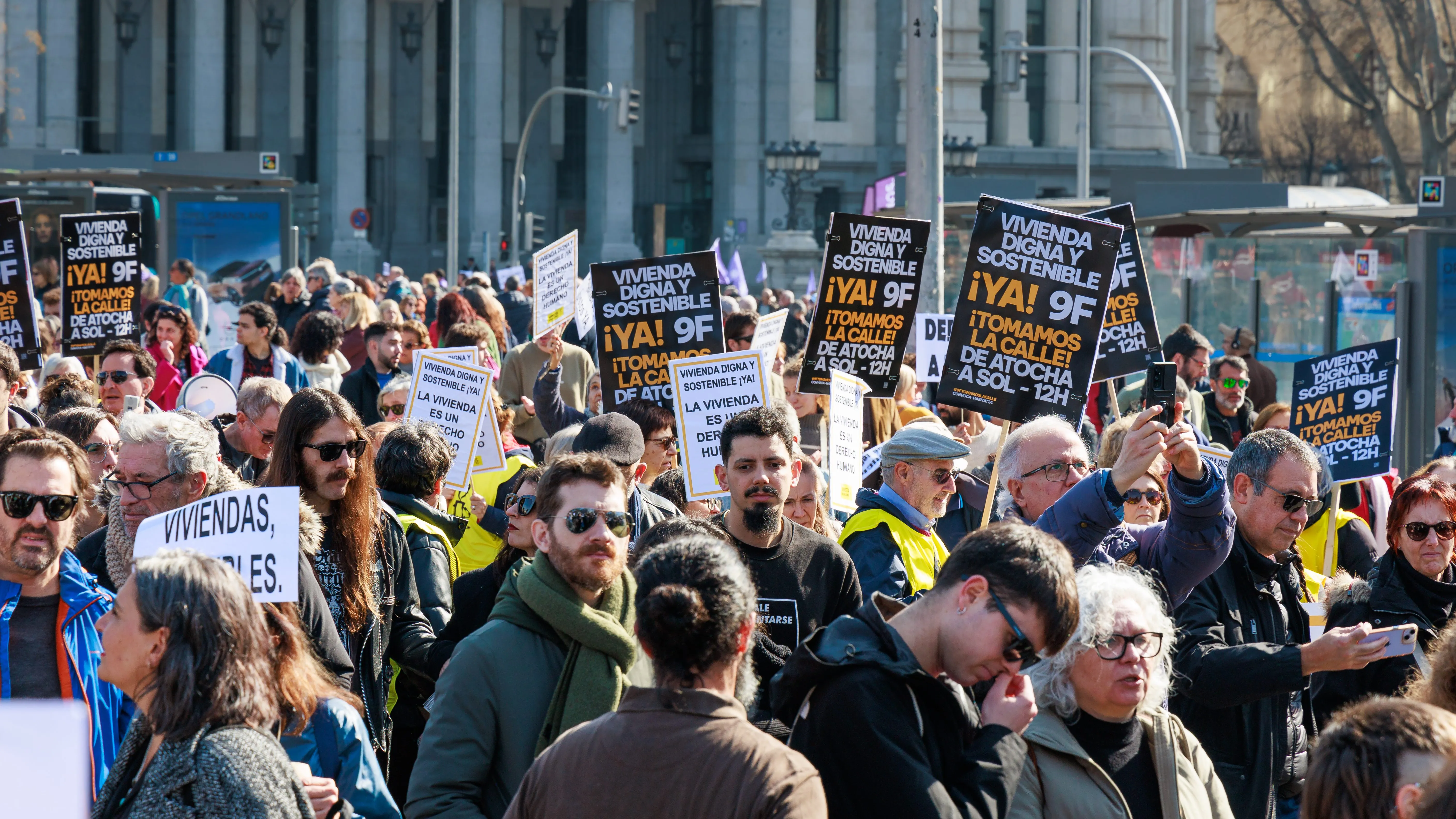
!Housing protesters march through Madrid demanding dignified housing and lower rents
Housing protesters in Madrid. Demonstrations over evictions and soaring rents have spread across Spain. Credit: Wikimedia Commons (CC BY-SA 4.0)
On Saturday, the anger spilled into the streets of the capital and beyond. Tens of thousands of demonstrators marched in Madrid, Valencia and Barcelona, with the government's own figures putting the Madrid protest at more than 70,000 people, according to Al Jazeera. The Madrid Tenants Union, one of the groups organising the protests, claimed that around 950,000 people took part in demonstrations across the country over the weekend — a figure that, while unverified, speaks to the scale of the mobilisation.
"This wave of indignation is unstoppable and we are not going to stop," Alicia del Río, a spokesperson for the Tenants Union, said, renewing calls for a general strike.
The statistics behind the fury are stark. Rents rose by 8.5 per cent in 2025, house prices climbed 12.2 per cent, and Spain is estimated to be short of some 700,000 homes. For young people and working families, the market has become not merely expensive but impenetrable — a dynamic that the Verity housing crisis coverage has shown is hardly unique to Spain, but one that has reached a political boiling point there first.
Sánchez's government attempted to answer the protests with two decree laws: emergency measures including strengthened protection against evictions, automatic renewal of tenancy contracts, restrictions on evicting vulnerable tenants, curbs on speculative purchases of homes, and a framework for capping rents. On Friday, parliament rejected both.
The arithmetic that killed the decrees
The defeat was inflicted by an unusual alliance. Junts, the right-wing Catalan separatist party whose votes have kept Sánchez in power since 2023, joined the conservative People's Party (PP) and the hard-right Vox in voting the measures down. For a prime minister who has governed without a majority since 2018, the vote was both a policy failure and a political signal: the parliamentary arithmetic he relied on to survive had stopped working.
Opposition leaders argued the defeat proved Sánchez no longer commanded a workable majority and that Spain needed a government capable of governing. Sánchez has inverted that logic. In his Monday address, he said Spain needed "to renew and broaden the support of the people" and "to secure a much broader, progressive majority in parliament" — language aimed squarely at the protesters. The message, as political analyst Eduardo Bayón put it: "Faced with an inability to legislate on the issue of greatest public concern, the aim is to capitalise on social mobilisation."
Sánchez has earned a reputation as Spanish politics' great survivor — a leader who has remained in office for eight years without ever winning a parliamentary majority, outlasting rivals who repeatedly wrote him off. As CNN noted, surveys indicate the snap vote could cost him his job and usher in a right-wing government, yet his appetite for risk has defined his career, from his open accusations against Israel over Gaza to his defiance of demands from Washington on defence spending.
His calculation appears to be that anger over the housing crisis will be directed more at the parties that voted down his decrees than at his own government. With thousands of activists camped in the capital outside offices run by the conservative PP, he may be trying to turn the election into a referendum on housing — shifting the narrative away from a summer of damaging headlines about his government's handling of a migrant crisis in the North African enclave of Ceuta and from the corruption investigations circling his party.
The polls point right
The risk is real. Recent opinion polls have generally placed the main opposition PP ahead of the Socialists, and the party's leader would most likely need the support of Vox — the hard-right party that voted against the housing decrees — to form a government. As the BBC's original report on the announcement made clear, that is the central tension of the campaign: a snap election called in the name of progressive housing reform could end by installing the very parties that blocked it.
Snap elections in Spain, however, have a record of confounding expectations. Sánchez's 2023 gamble — calling a vote after a disastrous round of regional elections — produced no outright winner but allowed him to stitch together the coalition that has kept him in Moncloa. He is betting he can do it again.
No account of Sánchez's decision is complete without the controversies that have shadowed his government. His wife has been charged in a corruption investigation, Socialist party headquarters have been raided by investigators, and a former minister was jailed for 24 years. The amnesty for Catalan separatists that allowed Sánchez to clinch a third term in 2023 continues to infuriate much of the country. His government has also been operating under its 2023 budget for years, having never managed to approve a new spending plan — a telling symptom of its parliamentary weakness.
Sánchez himself acknowledged on Monday that he had made mistakes and fallen short of previous campaign promises. "I also know that part of that social majority is dissatisfied today," he said, in a rare moment of public contrition that The Times highlighted as a sign of how seriously he takes the threat.
The deeper question is whether an election can solve a crisis that is fundamentally structural. Spain's housing shortage of roughly 700,000 homes cannot be legislated away in a campaign, and the forces driving prices — tourism, investment funds, stagnant wages — are continental in scale. Channel News Asia noted that Spain has been running on a years-old budget, and whoever wins will inherit the same fiscal constraints.
But elections are not policy instruments; they are verdicts. On 29 November, Spanish voters will deliver theirs on a government that tried to cap rents and was blocked, on an opposition that blocked it, and on an 87-year-old woman whose eviction became the image of a national emergency. For Sánchez, it is the gamble of a career. For Spain, it may be the most consequential vote on housing in a generation — and one that governments across Europe will be watching closely. More on this developing story will follow in our news section and on our homepage; read about our coverage standards here.