For Jeffrey Deaver, a 58-year-old retired timber cutter in Washington state, kratom was a lifeline. Plagued by chronic pain, he turned to the plant-based supplement and found relief he had not expected. "It was like a miracle," he said. "I could sleep. I could function." His fear now is losing access to it: "I just don't know what I'd do without it."
For the families of two University of Mississippi students, Aidan Hamilton and Robert Strang, kratom is something else entirely — a substance found at the scene of both young men's deaths, and the reason a father and son, Yahya Mohamed Mosleh, 51, and Islam Yahya Mosleh, 18, now stand accused of selling its derivatives. The juxtaposition of those two stories is the kratom debate in miniature: genuine relief for some, genuine alarm for others, and a regulatory vacuum in between.
The Ole Miss deaths sent a jolt through Mississippi. Law enforcement recovered packaged kratom sold from a retail store at both scenes and seized more than 500 units of the substance, and investigators arrested the Moslehs on accusations of selling kratom derivatives. Officials have been careful not to declare causation — a Lafayette County narcotics unit stressed it had no confirmed information that kratom or any other substance contributed to either death — but the optics were damning: two dead students, and a product marketed as a harmless herbal supplement sitting nearby.
The case revived a nickname that has haunted kratom for years: "gas station heroin". Sold in petrol stations, smoke shops and convenience stores across much of America, kratom sits on shelves next to energy drinks, looking for all the world like a wellness product. That ordinariness is precisely what alarms officials.
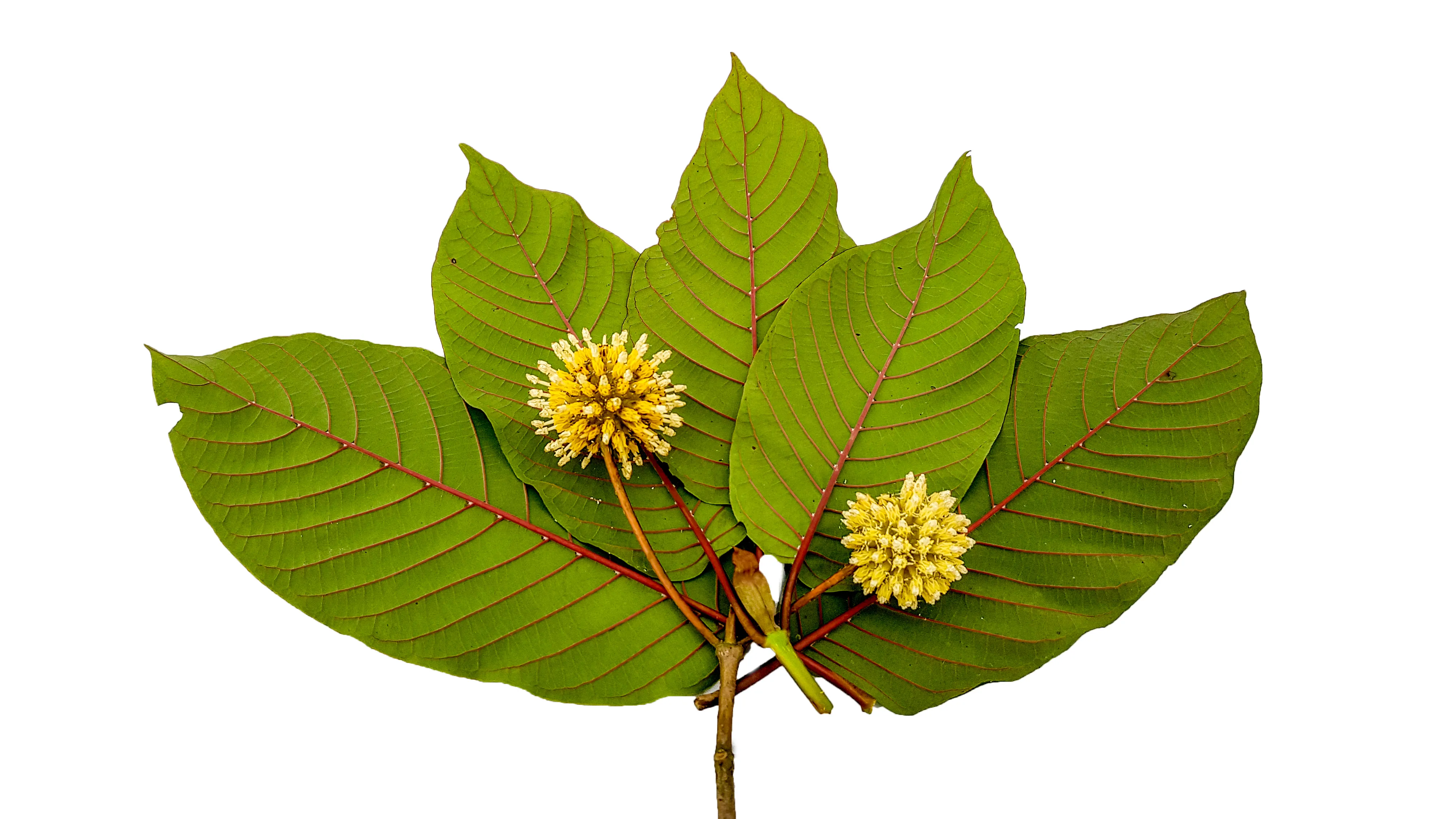
!Close-up of a single kratom leaf
Credit: ThorPorre, CC BY 3.0, via Wikimedia Commons
Kratom is the common name for Mitragyna speciosa, a tree native to South East Asia whose leaves contain dozens of bioactive alkaloids. The two that matter most are mitragynine and 7-hydroxymitragynine. In South East Asia, the leaves have been chewed for centuries by labourers seeking stamina; in the United States, kratom entered the market as a supplement around 2016 and has since spread into powders, capsules, teas, liquid extracts and even beverages.
According to the National Institute on Drug Abuse, kratom produces both stimulant-like effects at low doses and opioid-like effects at higher doses. People report using it for pain, fatigue, energy and — notably — to manage drug withdrawal symptoms and cravings, particularly those linked to opioids. NIDA notes that no kratom product is approved by the US Food and Drug Administration for any medical use, and describes kratom and kratom-based products as "legal and accessible in many areas" while research continues.
Deaver is not alone. A vocal community of users — and the American Kratom Association, which lobbies on their behalf — argues that kratom helps people manage chronic pain and step away from far more dangerous opioids. For them, the plant is harm reduction: a natural product keeping people out of the grip of prescription painkillers and street drugs. The Association has even pushed for bans on synthetic products "posing as natural kratom", a tacit admission that the market has a quality problem even from kratom's defenders.
There is, researchers concede, a kernel of plausibility here. NIDA itself says it supports research into potential medicinal uses of kratom and its compounds, and scientists are "very concerned" less about the traditional leaf than about the new wave of concentrated and semisynthetic products hitting shelves. What users buy in 2026 is often a long way from what a Thai labourer chewed a century ago.
Ask addiction clinicians, and the picture darkens. Dr Shane Speights, dean of the NYIT College of Osteopathic Medicine at Arkansas State University, traces the trouble to the modern market: "That's really where the problems began." His core complaint is the one that dogs every unregulated supplement: "There's no way to know exactly what you're getting." Products vary wildly in strength, and laboratory tests have found some contaminated with heavy metals or salmonella. At high doses, Speights warns, the effects are narcotic: "It's almost like taking a narcotic." And the deaths, he says, follow from that potency: "where the deaths come in."
Jana Wu, director of clinical integration at the addiction treatment centre Mountainside, sees the human cost up close. "It affects marriages, relationships," she said. "I've seen people lose jobs, spend thousands of dollars a month on it." Her patients' usage can be staggering: "I've worked with people that were taking like up to 20 pills a day." Anti-kratom campaigners put it more bluntly still: "gas-station drugs are poisoning our communities."
The clinical literature backs the caution. Health authorities in Pennsylvania warn that kratom can cause dependence with physical withdrawal symptoms, is addictive "just like morphine, heroin, or other opioids", and carries risks from liver injury to seizures. The FDA has warned consumers not to use kratom in any form, noting reports of liver injury, seizures, substance use disorder and deaths — often involving other substances. NIDA adds that rare but serious effects have been reported, including psychiatric, cardiovascular, gastrointestinal and respiratory problems.
!A Mitragyna speciosa kratom tree
Credit: Uomo vitruviano, CC BY-SA 3.0, via Wikimedia Commons
Regulation is a mess. Kratom is banned in 11 US states — Alabama, Arkansas, Connecticut, Indiana, Kansas, Louisiana, Massachusetts, North Dakota, Tennessee, Vermont and Wisconsin — with Massachusetts the most recent addition via a temporary emergency order in August. Ten years ago the DEA moved to classify kratom's key compounds as Schedule 1 drugs, calling the plant "an imminent hazard to public safety" — but the effort collapsed under political pressure and the plant remains unscheduled at federal level. It is a DEA "drug of concern" in legal limbo. America's struggle to control unregulated substances is hardly new; it plays out on a far bloodier stage in Ecuador's drug war, where police battle gangs, corruption and rising violence.
Outside America the lines are harder: kratom is banned in the UK, and in Malaysia it falls under the Poisons Act of 1952. That contrast — prohibition in Britain, open sale in most American petrol stations — captures how little consensus exists about a substance that behaves like a stimulant in the morning and a narcotic at night.
Here is what neither camp quite wants to say out loud: both sides are describing the same market failure, and neither banning nor blessing kratom fixes it.
The pro-kratom case rests on the leaf — a mild, traditional plant that some chronic-pain patients genuinely prefer to opioids. The anti-kratom case rests on the products — concentrated 7-OH extracts, gummies and shots that bear about as much resemblance to chewed leaves as vodka does to communion wine. When Dr Speights says "that's really where the problems began", he is pointing at a transformation the industry itself has engineered: taking a low-margin botanical and refining it into a high-margin intoxicant, then selling it next to the chewing gum.
That is why the American Kratom Association's call to ban synthetic products posing as natural kratom is the most interesting position in this whole fight. It is an admission that the "natural" brand is doing the heavy lifting — that consumers reaching for relief are actually buying potency they cannot measure, in products nobody is required to test. The FDA's warnings about contamination and the US Army's crime-prevention briefings on semisynthetic kratom both land in the same place: this is no longer a supplement problem, it is a drug-market problem wearing a supplement's clothes.
The honest policy question is not "ban it or free it" but "what, exactly, is being sold". A regulatory regime that distinguished leaf from extract, required testing and labelling, and kept the potent stuff behind a pharmacy counter would serve Deaver and the Ole Miss families better than either today's free-for-all or a blanket ban that would simply push users toward worse alternatives. Until that distinction exists, the debate will keep talking past itself — one side defending a plant, the other attacking a product, and neither naming the gap between them.
Mississippi's investigation is ongoing, and the Moslehs' case will test how far prosecutors can stretch existing law against sellers of kratom derivatives. At federal level, the long-stalled question of scheduling remains live: the DEA's failed 2016 move could be revived in some form, especially if more states follow Massachusetts into emergency restrictions. And researchers will keep doing the slow work of answering the question users and doctors both need answered — what this substance actually does to the human body over years, not weeks.
For families, the practical guidance from clinicians is already clear: kratom is not a safe product for children or teenagers, products are unregulated and inconsistent, and anyone using it alongside prescription medicines risks dangerous interactions — a familiar pattern for parents already fielding warnings about vaping's toll on children. As prevention specialists note, the lack of federal scheduling leaves the real decisions to state legislatures — which means the map of where kratom is legal will keep being redrawn, one emergency order at a time.
*VERITY is an independent digital news platform covering opinion, world news, business and more. Read about our editorial standards.*