A gift rooted in a sense of smell
Perfume founder Jo Malone has donated £100,000 to the charity Medical Detection Dogs to support research into a device that could one day detect cancer by smell. The donation will help develop a system called SniffSpace, which is designed to make the charity's scent detection work faster and more consistent, and to build the evidence base for an electronic nose that could be used far more widely than a team of trained dogs ever could.
Malone built her career on fragrance, and she has spoken openly about losing her own sense of smell during treatment for breast cancer in 2003. She later regained it, and the experience shaped how she talks about smell as something precious rather than abstract. In comments reported by the BBC, she said: "My sense of smell has given me so much throughout my life. So I have always wanted to find a way of using that world of smell to give something back." The donation, reported on 28 October 2026, connects that personal history to a very different kind of scent work: dogs trained to recognise the odour of disease in human samples.
The charity, based near Milton Keynes, trains dogs to detect disease from samples such as urine and breath. Its work sits at the intersection of animal behaviour, chemistry and clinical research, and it has drawn attention precisely because it starts from a simple observation. Diseases change the body's chemistry, and those changes can produce volatile compounds, tiny scent molecules, that a dog's nose may be able to pick up long before symptoms become obvious. Turning that observation into a reliable test is a much harder task, and it is the task Malone's donation is meant to advance. Readers interested in wider health research can follow similar stories in our health coverage.
What SniffSpace is meant to do
At present, the charity's dogs sniff samples arranged in up to eight stands, looking for odours linked to disease. After each row has been sniffed, trainers must record the results by hand and swap the samples around before the next round begins. That manual process limits how many samples can be tested in a given session, and it introduces the kind of small variations that researchers would rather avoid when they are trying to build a clean dataset.
SniffSpace is designed to change that routine. The system automatically rotates the samples, so more can be sniffed in a shorter period, and the results can be recorded in a more standardised way. A team of dogs will now be prepared for training on the equipment. The point is not to replace the dogs in the short term. It is to let them work more efficiently, and to gather a larger, better organised set of results that engineers and scientists can then use to train and test an electronic nose.
The distinction matters. Dogs are the proof that scent based detection is possible in principle. An electronic device would be the route to using that principle at scale, in clinics and hospitals where keeping and training large numbers of detection dogs would never be practical. Medical Detection Dogs has described this as its ultimate aim: an electronic nose that can do what the dogs do, but at scale across the world. That ambition is still a research goal, not a finished product, and any reporting of it should keep that distinction clear. The charity's own site describes its broader programme of training dogs to detect life threatening illness, and you can read more about the organisation through its official pages linked here.
The 500 samples at the centre of the work
The prototype electronic nose is currently testing 500 urine samples provided by patients from Milton Keynes Hospital. Dogs trained by Medical Detection Dogs had previously identified which of those samples were cancerous. Once the prototype has produced its own dataset from the same samples, researchers will be able to compare the machine's results with the dogs' results, sample by sample.
That comparison is the core scientific test at this stage. If the prototype can match the dogs' performance on samples whose status is already known, it will have passed an important early hurdle. If it cannot, researchers will learn where the device falls short, whether in sensitivity, in consistency, or in the way it handles borderline samples. Either outcome is useful, but neither outcome on its own would prove that a working clinical test exists. A device that performs well on one set of samples still needs to be tested on new samples, in different settings, and against the tests clinicians already use.
The focus of this phase is prostate cancer. That choice reflects a genuine clinical problem. Prostate cancer is common, and the blood test most often used in initial assessment, the prostate specific antigen test, is known to be imperfect. It can miss cancers, and it can also point to problems that turn out not to be cancer, leading to further tests and anxiety. A scent based test would not need to be perfect to be valuable, but it would need to show, in proper trials, that it adds real information beyond what doctors already have. That is why the charity and its technology partner are talking about future diagnostic devices for the NHS to consider, rather than claiming a test is ready now. For context on how cancer screening is debated in the UK, readers can also explore our news coverage of health policy.
A partnership aimed at NHS use
The technology partner in the project is RealNose.ai. According to reporting of the announcement, the company and Medical Detection Dogs are focused on establishing a formal partnership aimed at creating laboratory diagnostic devices specifically for the NHS to look at as potential solutions to prostate cancer screening and early diagnosis problems, before trying the same scent based approach for other cancers.
That framing is cautious in a helpful way. It places the NHS as an evaluator of a future device, not as a buyer of a current one, and it names prostate cancer as the starting point rather than promising a general cancer test. Other cancers may follow if the approach proves itself, but the reporting does not present that as a certainty. The charity has previously studied a range of conditions, and earlier research on prostate cancer detection by dogs reported sensitivity of around 71 percent and specificity of 70 to 76 percent for high grade disease in one study, figures that show promise without suggesting the problem is solved.
The donation itself is also worth placing in context. At £100,000, it is a significant gift for a charity that says it needs to raise around £7,000 each day to continue its work, and it arrives at a practical moment, when new equipment and dog training both cost money. It will not, on its own, fund a finished medical device through regulation and into clinics. Medical devices require validation, manufacturing, safety testing and approval, each of which takes time and funding well beyond a single donation. What it can do is move the research from a slower, manual phase to a faster, more systematic one, and that is how the charity has presented it.
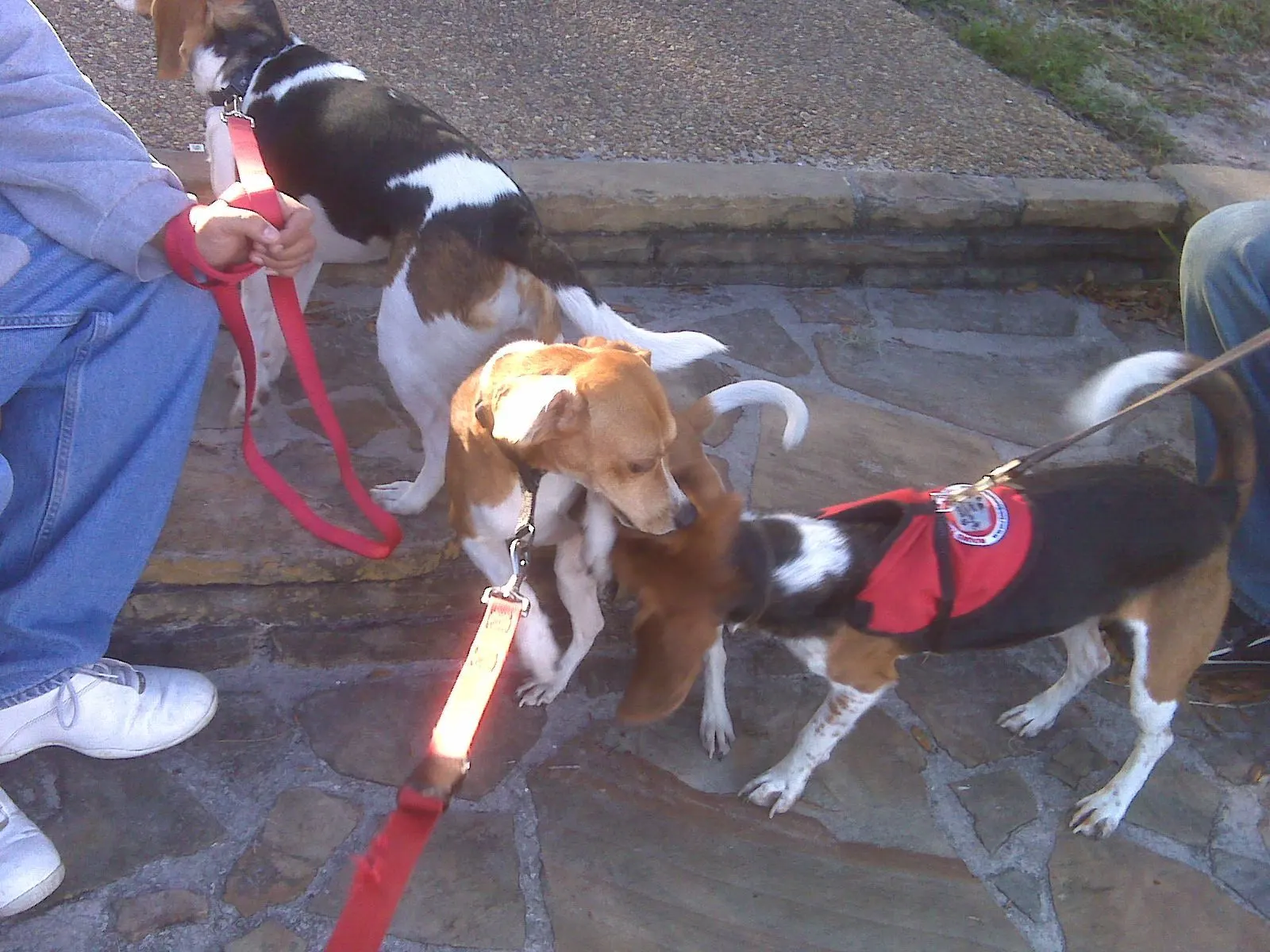 Three beagles trained for scent detection work
Credit: MarceloGallo via Wikimedia Commons, CC BY-SA 3.0. Illustrative image of scent detection dogs.
Why dogs can smell disease at all
Dogs have around 300 million scent receptors, compared with about five million in humans, and the part of a dog's brain devoted to smell is far larger, relative to brain size, than the equivalent area in people. That biology explains why dogs can be trained to find explosives, drugs and missing people, and why researchers began to ask whether the same ability could be turned to disease.
The idea is not new. Doctors have noted for centuries that some diseases carry a characteristic odour, and modern chemistry has confirmed that cancer cells can release small amounts of volatile substances. The challenge is that human samples contain hundreds of such substances, from diet, medication, infection and everyday metabolism, and picking out a reliable cancer signal from that background noise is difficult. Dogs learn by reward and repetition, and they can learn to alert to a target odour even when researchers do not yet know exactly which molecules matter most. Machines, by contrast, need that chemistry to be identified and built into sensors, which is one reason the dog phase of the research remains so important.
There are also practical limits to dog based testing that an electronic nose could solve. Dogs tire, they need rest, training and care, and their performance can vary with mood, health and environment. A machine would not replace the need for careful clinical trials, but it could, in theory, test samples around the clock, in standard conditions, and at a cost that health systems could afford. That is the long term prize, and it is also the reason scepticism remains healthy. Many promising detection methods look strong in early studies and weaker when tested on larger, more diverse groups of patients. The 500 sample comparison now under way is a step toward answering that question, not the answer itself.
What happens next, and what to watch
The next milestones are straightforward to state, even if they will take time to reach. The dogs will be trained on SniffSpace, the prototype will complete its run through the 500 samples, and researchers will publish or report how closely the machine matched the dogs. After that, the work would need to move to larger sample sets, to samples collected prospectively from people whose diagnosis is not yet known, and to comparisons with existing tests in real clinical pathways.
Patients and families should not change any health decisions on the basis of this announcement. Anyone with symptoms that could suggest prostate cancer, or any other cancer, should still seek care through their usual doctor and the tests currently recommended, rather than waiting for a scent based test that is not yet available. The value of early diagnosis is well established, and delay is a real risk. The promise of this research, if it succeeds, is that future patients might have an additional, non invasive tool to help clinicians decide who needs further investigation sooner. That is a meaningful goal, and it is enough, without overstating where the science stands today.
Malone's gift also highlights a wider point about how medical research is funded in the UK. Charities fill gaps that public funding does not always reach, especially for ideas that sound unusual at first. Scent detection sounded unusual when Medical Detection Dogs began its work in 2008. Nearly two decades later, it has produced peer reviewed studies, hospital partnerships and a prototype device. The donation does not guarantee a breakthrough, but it keeps a distinctive line of research moving at a moment when its next test is already under way. That, for the patients whose samples are now being sniffed by a prototype machine in Milton Keynes, is the most concrete thing that can be said. For more on medical innovation, see our science section, our world coverage, and the homepage for the latest stories. You can also learn about the site itself on our about page.