A life measured in transfusions — until now
For most of her life, Vian's calendar was dictated by blood. The 16-year-old from Coventry was born with thalassaemia, an inherited disorder that stops the body making enough healthy haemoglobin, and like many patients she needed a blood transfusion roughly every month. Each session meant hours in hospital, and a lifetime of iron-chelation drugs and injections to manage the damage the transfusions themselves caused.
Then, last December, she received back her own stem cells — edited. Doctors had taken the cells from her bone marrow, used the CRISPR gene-editing tool to reprogramme them in a laboratory, and returned them to her body. The result, her doctors say, has been transformative: Vian no longer needs monthly transfusions. Those who treated her describe the outcome as a "functional cure" — a phrase that would have sounded like science fiction to the families sitting in transfusion wards a decade ago.
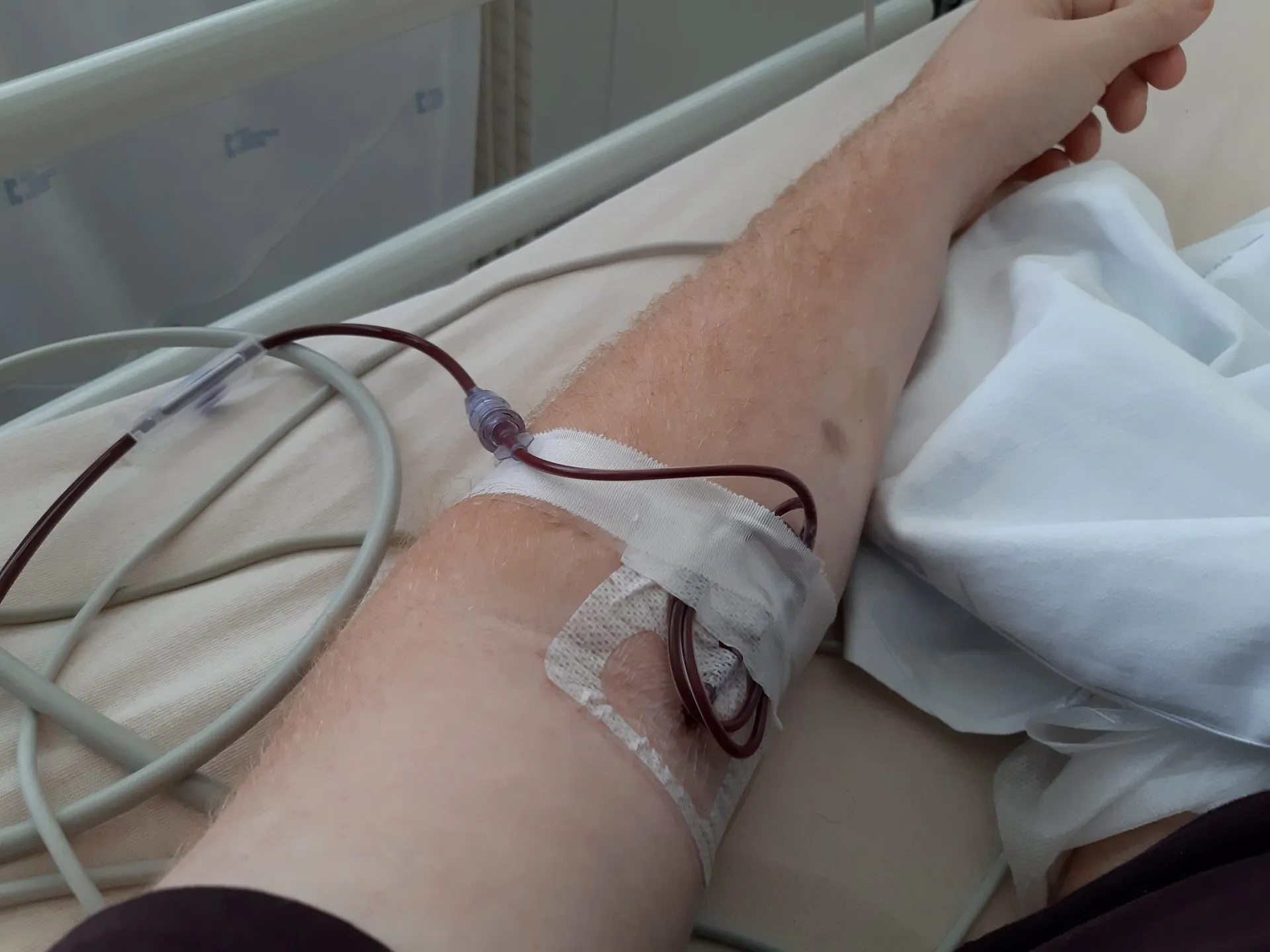 A blood bag during a transfusion procedure.
Credit: CC0 public domain dedication, via Wikimedia Commons.
Vian's story is not an isolated experiment. At Birmingham Children's Hospital, another teenager is at the start of the same journey. JoelSamuel, 14, from Oldbury, has sickle cell disease — a related inherited blood disorder that leaves him in excruciating pain and exhausted by ordinary activity. His stem cells have recently been collected; they will be edited, and in around six months he will undergo chemotherapy before the edited cells are returned to him. "I get tired and then the next day I get sick and I won't be able to go to school," he said of his current life. He dreams, simply, of being able to enjoy sport. He was nervous at first, he admitted, but hopeful: "I think it's good to make me better, so I can go and do stuff that takes my energy."
How the treatment works
The therapy, marketed as Casgevy and known scientifically as exagamglogene autotemcel (exa-cel), is the first CRISPR-based medicine ever approved for use — a landmark the UK can claim. The MHRA authorised it in 2023 for patients aged 12 and over with sickle cell disease or transfusion-dependent beta-thalassaemia, making Britain the first country in the world to license a gene-editing treatment for these conditions.
The process is intricate. Stem cells are extracted from the patient's bone marrow and shipped to specialist laboratories, where CRISPR — the gene-editing tool whose inventors won the Nobel Prize in chemistry in 2020 — is used to edit them. The edit reactivates the production of foetal haemoglobin, a form of the oxygen-carrying protein that compensates for the faulty adult version. Meanwhile the patient receives high-dose chemotherapy to clear space in the bone marrow; the edited cells are then infused back, like a transfusion in reverse. If all goes well, the modified cells engraft and begin producing working haemoglobin — with results that, in trials, have the potential to be life-long. Britain's approval made it the first country in the world to license a CRISPR-based therapy for these conditions.
The science has been building toward this moment for years. Our science coverage has followed the Nobel prizes recognising the foundational discoveries, including this year's chemistry prize for work on homochirality. But the leap from laboratory to clinic has been unusually fast — and unusually closely watched.
What the evidence shows
The strongest evidence comes from the clinical programme behind the approvals. In trials, the treatment restored healthy haemoglobin production in the majority of participants with sickle cell disease and transfusion-dependent beta-thalassaemia, relieving the symptoms of disease, according to the MHRA's assessment at authorisation.
That picture has since been reinforced. A study published in the New England Journal of Medicine found that exa-cel delivered significant clinical benefits for children with both conditions, editing patients' own bone marrow cells to produce functional haemoglobin. And in routine — not experimental — care, doctors at Berlin's Charité hospital reported this year treating a 19-year-old beta-thalassaemia patient with the EU-approved version of the therapy, ending his transfusion dependence. More than 900 million edited stem cells were infused in May; about 40 days later he began producing the missing haemoglobin, his total haemoglobin reached the normal range, and regular transfusions were no longer needed.
Vian's case, treated on the NHS, adds a British chapter to that record — alongside other young patients such as Adam, 13, from Oldham, whose ground-breaking £1.65m treatment at Royal Manchester Children's Hospital has given him his freedom back. She is among the first generation of patients for whom an inherited blood disorder is not necessarily a life sentence of hospital appointments.
The caveats doctors insist on
For all the excitement, the doctors involved are careful with their language — and with good reason. The preconditioning chemotherapy is punishing: patients can suffer painful inflammation of the mouth and gut, liver injury, and very likely infertility. It is the price of clearing the marrow, and it is not a small one.
Regulators, too, are cautious. The European approval was granted conditionally, with a mandatory 15-year follow-up, because the long-term safety and durability of the edited cells remain unproven. The therapy requires complex logistics and specialist centres, which means only a limited number of patients can be treated each year — and payer arrangements, including confidential reimbursement deals with the manufacturer, will shape how widely it reaches those who need it.
There are also questions of equity that the UK cannot ignore. Sickle cell disease disproportionately affects people of Black African and Caribbean heritage, a community that has long reported poorer experiences of NHS care. Whether a spectacular but expensive and capacity-limited therapy narrows or widens health inequalities will depend on how deliberately it is rolled out. The NHS's broader struggles with waiting lists and winter pressures form the backdrop against which any new treatment must be delivered.
A second chance, and a second teenager
Back in Birmingham, JoelSamuel's treatment is only just beginning. His cells have been collected; the editing, the chemotherapy and the reinfusion lie ahead. His doctors will be watching for the same signs they saw in Vian: rising haemoglobin, fading symptoms, a life no longer scheduled around the transfusion ward.
For Vian's family, the change is already real. The teenager who spent her childhood in hospital chairs now faces a future her parents could not have imagined when she was diagnosed. Medicine has not rewritten her genes in every cell of her body — but by editing the stem cells that make her blood, it has rewritten what her blood disorder means.
As the treatment moves from trial to routine care, her case will be studied as closely as any in the programme. The hope, shared by her doctors and by families waiting behind her, is that "functional cure" becomes not a phrase for the remarkable few, but a description of the standard of care.
You can follow more of Verity's health reporting — including our coverage of teen mental health and technology — on the homepage. Learn more about our mission on the about page.