Arsenal decide to challenge the dismissal
Arsenal will appeal against the red card shown to Max Dowman in Tuesday night's shock Carabao Cup defeat at Fleetwood Town. The 16-year-old was sent off in the 85th minute of the fourth round tie, and the club plans to challenge the decision with the Football Association, according to Sky Sports News reporting and Press Association reporting. The appeal matters beyond one cup tie, because a straight red card for violent conduct carries a three-match domestic suspension, and Arsenal want that ban overturned before it bites into their Premier League programme.
The timing is tight. Appeal documents must be submitted to the Football Association by 1pm on Thursday, according to Sky Sports News and the Press Association, and Arsenal hope a decision will be made before they travel to Liverpool in the Premier League on Sunday. The timing of the verdict itself will be determined by the Football Association, so the club cannot guarantee a ruling before the weekend. That uncertainty leaves manager Mikel Arteta planning for two versions of Sunday: one with Dowman available, and one without him.
Dowman's case will turn on how the incident is judged. He was dismissed for violent conduct after kicking out at Fleetwood midfielder Harrison Neal following a heavy challenge from the League Two player. Reports differ slightly on the detail: some describe a clear kick out, while others note that Dowman did not fully kick out but that his foot did make contact with Neal, according to further reporting on the incident. That distinction could matter to an appeal panel, which must decide whether the referee's decision was an obvious error. Arsenal's argument, in essence, will be that the incident did not meet the threshold for violent conduct, a charge that under the laws of the game covers using or attempting to use excessive force or brutality against an opponent when not challenging for the ball, regardless of whether contact is made.
A cup shock that ended on penalties
The red card came at the end of a night that already counted as one of the biggest upsets in Carabao Cup history. Fleetwood Town, of League Two, beat Arsenal 5-3 on penalties after a 1-1 draw at Highbury Stadium, according to reporting on the tie. Arsenal had 78 percent of the possession and 26 shots to Fleetwood's three, but they could not turn that dominance into a second goal, and they paid for it in the shootout.
Fleetwood took the lead in the 21st minute through Aaron Loupalo-Bi, after a disjointed first half from an Arsenal side showing nine changes. Arteta introduced Martin Odegaard and Ben White at half-time, and Viktor Gyokeres equalised in the 50th minute for his first goal of the season. Arsenal then had chances to win the match, including three big chances with ten men after Dowman's dismissal, according to Arteta's post-match assessment. Fleetwood goalkeeper Jay Lynch saved from White and Odegaard in stoppage time to force the shootout, Bruno Guimaraes had a penalty saved, and Conor Haughey, aged 19, scored the winning kick to send Fleetwood into the quarter-finals and prompt a pitch invasion.
There was no video assistant referee available for the tie, a fact that adds context to the red card debate. Referee Michael Salisbury had to judge the incident in real time, without the chance to review replays, and his decision stood on the night. That is normal for this stage of the competition, but it also means the appeal panel will be reviewing footage that the match officials did not have in the same form. Appeals of this kind often hinge on that gap between a live decision and a slower, frame by frame review.
Arteta's words to Dowman
As Dowman left the pitch and headed towards the tunnel, Arteta leaned in and spoke briefly to the teenager as he passed the dugouts. The exchange drew comment, with some pundits suggesting the manager should have put an arm around a young player at a difficult moment. Arteta, asked afterwards what he had said, declined to give details. He said: "It was something that we discussed before the game." Pressed further, he refused to elaborate, leaving the precise nature of the conversation unclear.
Arteta did offer a broader explanation of his message to the squad. He said: "When we prepared the context of the match, we were very clear on the things to expect, the things that emotionally we have to dominate. It was very clear." That comment, repeated in several reports, suggests Arteta believes the team had been warned about the emotional demands of a cup tie away at a lower league side, where heavy challenges, a partisan crowd and a rising sense of occasion can test discipline. Dowman, at 16, was experiencing that test at the highest level of his young career, and the red card will now form part of his education, whatever the appeal panel decides.
On commentary duty, Andy Hinchcliffe described the red card as harsh on Dowman, and Arteta responded with caution. He said he had not seen the incident clearly on camera, adding: "You can't really see what happens. The decision was made by the referee and that's it." That restraint is notable, because managers often speak more freely after a controversial dismissal. Arteta's choice to back the process, while still pursuing an appeal, keeps the club's challenge focused on the formal grounds rather than on public pressure.
A second red card in a month
The Fleetwood dismissal was Dowman's second red card this month, after he was also sent off while representing England's under-19 side. That sequence will concern Arsenal's coaching staff, even if they believe the Fleetwood decision was wrong. Young players who play with intensity and edge often walk a line between aggression and indiscipline, and learning where that line sits is part of development. Two dismissals in quick succession, for different teams and in different competitions, suggest a pattern that needs attention, regardless of the outcome of this appeal.
That context should not be overstated. Dowman is 16, playing senior football far earlier than most players of his age, and he is doing so in matches where opponents target him physically and crowds expect a contest. The heavy challenge from Neal that preceded the incident is part of that reality. None of that excuses a kick out, if that is what the panel finds, but it does explain why Arsenal are likely to treat the episode as a coaching matter as well as a disciplinary one. The club's public stance, appealing the card while keeping its private message to the player private, fits that approach.
Captain Martin Odegaard, speaking after the defeat, urged the squad not to dwell on the cup exit. He said: "It's very frustrating to go out. Obviously, the way we've played was not on the level. We need to do much, much better than we did." He added congratulations to Fleetwood and said the team looked forward to the next game and bouncing back. That message, from the captain rather than the manager, carries its own weight, and it sets the tone for a week in which Arsenal must recover quickly for Liverpool.
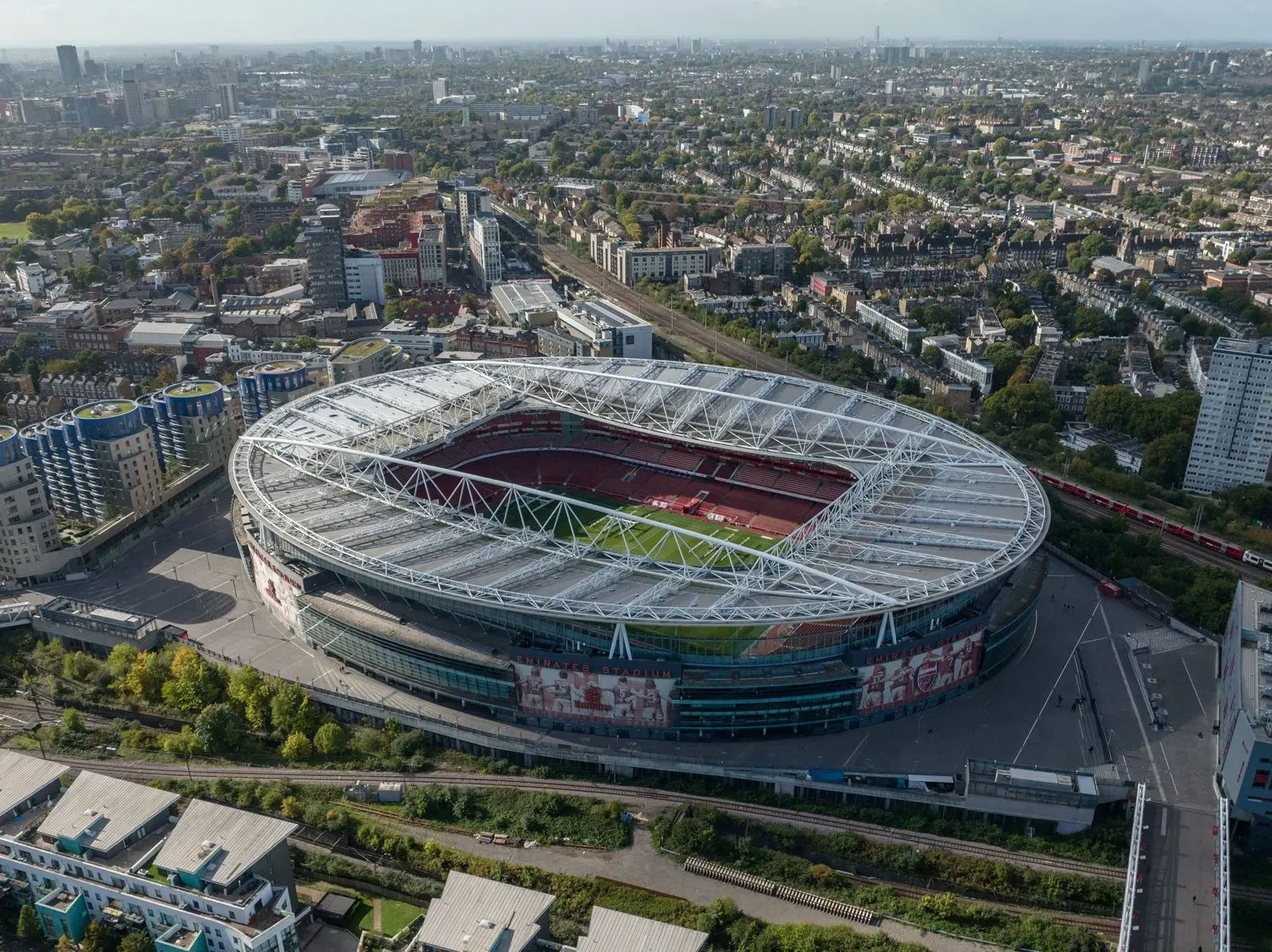 Emirates Stadium in London, home of Arsenal Football Club
Credit: Arne Mueseler, via Wikimedia Commons, CC BY-SA 3.0 de.
What the ban would mean if the appeal fails
If Dowman loses his appeal, the consequences are clear and significant. A three-match domestic suspension would rule him out of Sunday's Premier League trip to Liverpool, the home match against Hull City on 7 November and the visit to Newcastle United on 21 November. He would be available again for domestic matches when Arsenal host Manchester City on 29 November. For a young player breaking into the senior squad, missing three league fixtures, including two away trips to difficult opponents, is a real setback, even if it is not a long ban by professional standards.
The suspension would not apply to European competition. Dowman would remain available for Champions League matches, including the trip to Slavia Prague on 4 November and the home match against Borussia Dortmund on 24 November, according to reporting on the scope of the ban. That distinction matters for Arteta's planning, because it means Dowman can still gain experience at a high level while serving a domestic ban, and it keeps him involved with the squad rather than sidelined entirely.
Arsenal's wider injury picture adds to the pressure. The club is already light on wide options, with Bukayo Saka among those out injured, and reports mention further fitness concerns around Christos Tzolis, Noni Madueke, Declan Rice and Mikel Merino, with hopes that some will return for Liverpool. Losing Dowman as well, even for three matches, would narrow Arteta's choices further at a busy point in the season. That is one practical reason the club is appealing promptly, rather than accepting the ban and moving on.
The appeal process itself is straightforward in form but uncertain in outcome. Arsenal must submit their documents by the Thursday deadline, the Football Association will consider the case, and a panel will decide whether the red card should stand. The club hopes for a decision before Sunday, but the Football Association controls the timetable, and there is no guarantee of a ruling in time. If the panel upholds the dismissal, Dowman serves the ban. If it overturns the card, he is free to play at Anfield, and the Fleetwood defeat, painful as it was, will at least not carry a further cost into the league campaign.
A test of judgement, for player and panel
Appeals like this one are, at heart, tests of judgement. The panel must decide whether a young player's reaction to a heavy challenge crossed the line into violent conduct, or whether the referee, acting without video review in a fast moving cup tie, got a difficult call wrong. Dowman must learn, whatever the outcome, that retaliation invites punishment even when provoked, and that senior football judges reactions as harshly as challenges. Arsenal must decide how to support a teenager in the spotlight without excusing behaviour that could cost the team again.
For supporters, the appeal offers a small measure of hope after a chastening cup exit. Fleetwood's victory will stand regardless of the panel's decision, and Arsenal's hopes of lifting the Carabao Cup are over for this season. But a successful appeal would at least preserve Dowman's availability for Liverpool, a match that matters far more to the club's season than a single cup tie. A failed appeal would leave Arsenal to regroup without him, and leave Dowman to reflect on two red cards in a month while he waits for his next domestic appearance. Either way, the coming days will tell the club, and the player, something useful about where the line sits. Readers can follow more sports coverage on the Verity homepage and find the newsroom's contact page, plus background on the site on the about page and other news coverage.