Manchester United head coach Michael Carrick has said he is genuinely looking forward to Tuesday's Champions League game against Roma at Old Trafford, even though his side arrive at the fixture without a win in nine matches in all competitions. Speaking at his pre-match media conference on Monday, Carrick admitted that his excitement might sound strange given United's recent results, but he insisted that his focus is fixed entirely on making it a big night under the lights.
"You might think I'm crazy with the results we've had and what's going on, but I genuinely can't wait for the game," Carrick said, according to the BBC report on his pre-match conference. He added that he cannot look into the future and does not know what will happen next, but that uncertainty has not changed how he feels or how his team are preparing. "I'm actually really looking forward to the game," he said. "Whatever happens is going to happen after that in whatever direction it goes in, but we want to make it a big night tomorrow night first."
The message was deliberately defiant. AFP coverage of the same press conference carried the same account of Carrick brushing aside suggestions that he has only two games left in charge. Carrick, who signed a two-year contract in the summer, is in his first full season in charge, and the pressure around his position has grown with every game that has passed without a victory. There is now a growing feeling that he could lose his job during the forthcoming international break, which follows Sunday's Premier League game against Aston Villa. Asked directly whether he felt he had only two games left in charge, against Roma and Villa, Carrick answered plainly: "No, not at all."
For readers following the wider sporting picture, our Sports section carries ongoing coverage of major fixtures, while the homepage brings together the day's leading stories across every category.
A defiant message before a defining night
Carrick's tone mattered as much as his words. Managers under pressure often retreat into caution, speaking about taking one game at a time and refusing to look beyond the next training session. Carrick did something different. He acknowledged the scale of United's problems without hiding behind them, and he framed Tuesday's game as an opportunity rather than a threat. That is a difficult balance to strike when a team has not won for so long, because optimism can easily sound disconnected from reality. Carrick tried to avoid that trap by pairing his enthusiasm with honesty about the results.
He was clear that he cannot control speculation about his future, and he did not try to. Instead, he returned again and again to preparation and to the game itself. The approach will either look brave or naive depending on the result on Tuesday night, but it at least gives his players a clear message to carry onto the pitch: the manager is not waiting for bad news, he is waiting for kickoff. In a week when every result is being read as a verdict on his tenure, that distinction could matter inside the dressing room even if it changes nothing in the wider debate outside it.
Nine games without a win
The numbers behind Carrick's press conference explain why the questions about his future have become so persistent. United have gone nine matches without a win in all competitions, their worst run since 1988-89. They have not gone ten games without a win in a single campaign since 1977-78, which means Tuesday's game carries a piece of unwanted history as well as three important points. The most recent defeat came at Chelsea on Saturday, a 2-0 loss that extended the winless sequence and deepened the sense of a season drifting off course.
In the Premier League, United sit 17th, far below where a club of their resources and expectations believes it should be. In Europe the picture is no brighter. After defeats by Atletico Madrid and Como, United have slumped to 21st in the Champions League table after three games. With only the top 24 teams progressing from the league phase, United are still inside the qualifying places, but only just, and their margin for error is shrinking with every round. A home game against in-form opponents is therefore not just another fixture. It is a chance to steady a European campaign that is in danger of slipping away before it has properly begun.
The scale of the problem is also visible in the league table. United are only a short distance above the relegation places, and every dropped point increases the pressure on a squad that already looks short of confidence. Carrick knows that context better than anyone, which is why his insistence that he cannot wait for the game drew so much attention. It was not the language of a manager trying to buy time. It was the language of a manager who believes a single result can still change the mood around his team.
Mainoo and the belief inside the dressing room
Kobbie Mainoo sat alongside Carrick at the media conference, and the 21-year-old midfielder offered his own version of the same message. Mainoo has just returned from a four-match absence with a muscular issue, coming on as a second-half substitute at Chelsea, and he spoke about a squad that still believes its fortunes can turn quickly. United, he said, are one win away from changing the narrative of their season.
That phrase has become familiar in football, but it carries a specific meaning for this United side. A winless run creates its own momentum. Players begin to expect setbacks, crowds grow anxious at the first sign of trouble, and opponents arrive believing they can get something from the game. Breaking that cycle usually takes one performance in which everything clicks: an early goal, a disciplined defensive display, and a finish to the game that does not invite late drama. Mainoo's point was that United do not need to fix everything at once. They need one night when the result matches the work they believe they are doing behind the scenes.
Mainoo's return is also significant in its own right. At 21, he is one of the younger voices in the squad, but he has already experienced enough of United's recent turbulence to understand what a turning point looks like. His presence beside Carrick at the press conference was a small signal in itself, a reminder that the manager still has players willing to stand with him in public at a difficult moment. Whether that unity survives another defeat is a different question, and Tuesday will provide at least a partial answer.
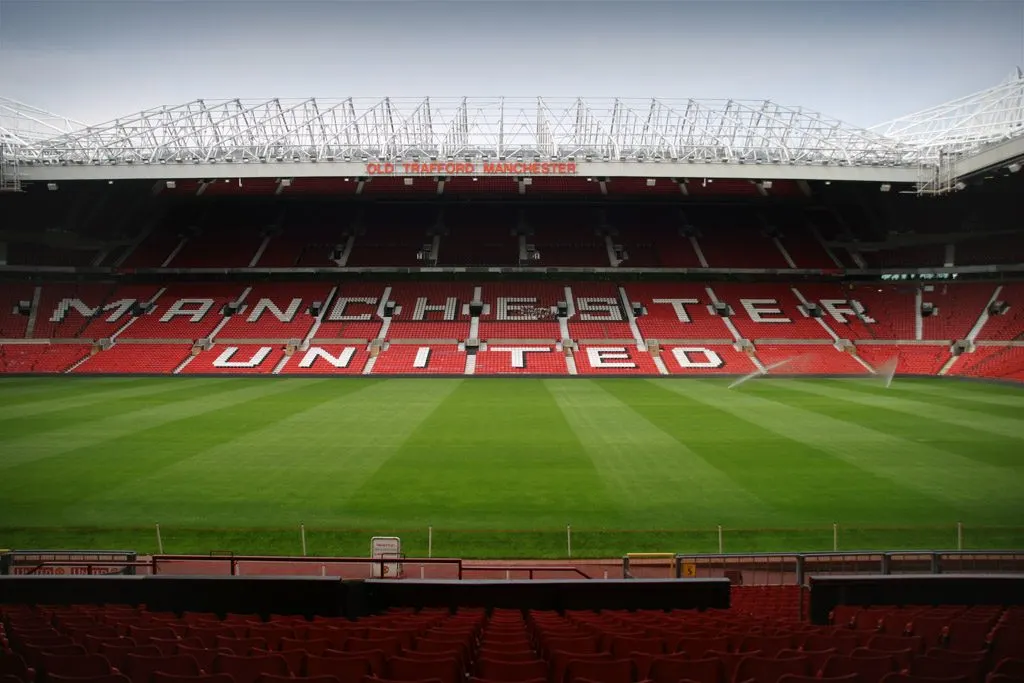 Inside Old Trafford stadium in Manchester
Illustrative archive image: the interior of Old Trafford. Photo by Andre Zahn via Wikimedia Commons, CC BY-SA 2.0 Germany.
Training ground signs at Carrington
If Carrick's words were upbeat, the open training session at Carrington offered some supporting evidence. Bryan Mbeumo and Carlos Baleba were particularly vocal during the pre-match session, while Lisandro Martinez was fully engaged despite his red card at Chelsea, which had triggered a strongly negative reaction. Carrick dismissed concerns about Martinez's commitment and about the commitment of the whole squad, saying that commitment is not an issue. The problem, in his assessment, is execution: the team needs to play better and make better decisions.
That distinction is important. Questions about commitment are often the most damaging questions a manager can face, because they suggest a dressing room that has stopped trying. Carrick rejected that reading outright. By separating effort from quality, he protected his players on one front while challenging them on another. The message to Martinez in particular was unmistakable. A red card can easily become a symbol of indiscipline, but Carrick treated it as an isolated incident rather than evidence of a wider attitude problem.
Mbeumo and Baleba's vocal presence in training also matters. Teams in poor form can go quiet, with players retreating into themselves and communication on the pitch drying up. A loud, energetic session does not guarantee a good performance, but silence would have been a worrying sign. Carrick watched over a lively session, and the players who stood out were the ones setting the tempo rather than following it. For a manager trying to convince his squad that a turnaround is possible, that kind of training ground energy is a useful starting point, even if it proves nothing on its own.
Roma arrive in form
Roma, by contrast, arrive at Old Trafford in strong shape. Their only defeat so far this season came at home to Real Madrid in the Champions League last month, when they led 3-1 with seven minutes left before losing the game. That result says two things about Tuesday's visitors. First, they are capable of troubling even the strongest sides in Europe. Second, they know what it feels like to let a winning position slip late, which could make them especially determined to see out a lead if they find one at Old Trafford.
For United, that combination makes the fixture even more demanding. Roma will not arrive hoping merely to survive. They have already shown they can compete with Real Madrid, and they will see a United side without a win in nine games as an opportunity to take control of the tie. United's defensive record and decision making in key moments will therefore be tested by opponents who are confident, organised, and in no mood to offer encouragement to a struggling home side.
The UEFA Champions League league phase format adds another layer to the contest. With only the top 24 teams progressing, every point matters, and a home defeat would leave United's position looking fragile with difficult fixtures still to come. A win, on the other hand, would lift United up the table and give Carrick exactly the kind of result Mainoo described: one win that changes the story. That is why Tuesday feels bigger than an ordinary group stage game, and why Carrick's talk of a big night resonated beyond the usual pre-match routine.
What is at stake in the league phase
It is worth pausing on what United actually need from this competition. The Champions League league phase rewards consistency across eight games rather than brilliance in one or two, and United's start has been poor. Defeats by Atletico Madrid and Como have left them chasing the pack rather than setting the pace, and a third defeat in four games would leave them needing a strong finish just to stay in contention. The club's official channels at Manchester United will carry team news and reaction, but the mathematics of the table are simple enough: United need points, and home points matter most.
There is also the question of momentum across competitions. A Champions League win does not fix a Premier League position of 17th, but it can change the atmosphere around a club in a way that carries into the next league game. Confidence is not an abstract quality in football. It shows up in first touches, in willingness to take a shot, and in calmness when defending a lead. United have looked short of all three during their winless run, and Carrick will hope that a European night at Old Trafford, with a full crowd behind the team, provides the setting for those qualities to return.
The alternative is stark. Another defeat would extend the winless run to ten matches, matching a sequence not seen in a single campaign since 1977-78, and it would send United into the Aston Villa game and then the international break with speculation at fever pitch. Carrick has refused to entertain that scenario in public, and he is right not to. Managers cannot prepare for a game by rehearsing its worst outcome. But everyone around the club understands the stakes, and Tuesday's result will shape the conversation for the rest of November whether Carrick wants it to or not.
A fixture with history
United against Roma is a fixture with real European history, and Carrick has personal memories of it. As a player under Sir Alex Ferguson, he scored twice in United's famous 7-1 Champions League quarter-final second leg win over Roma in 2007, one of the great European nights in Old Trafford's history. That memory will mean little to the current squad unless they create their own version of it, but it explains part of Carrick's affection for this fixture. He knows what a big European night at Old Trafford can feel like, because he has lived one.
For supporters, that history cuts both ways. It is a reminder of what United used to be in Europe, and a measure of how far the club has fallen from those nights. But it is also a reminder that Old Trafford on a European night can still be a difficult place for visiting teams, even when the home side are struggling. Roma will be aware of that history too, and they will know that an early United goal could change the entire atmosphere inside the stadium.
Beyond this one tie, the wider sporting landscape continues to produce stories of comebacks and breakthroughs. Our News section and World section follow the biggest developments beyond sport, while recent Verity sport coverage includes Carlos Alcaraz's Vienna Open triumph and our report on the death of European champion Ciara Mageean. Those stories, like this one, are about athletes and teams responding to pressure, and they are a reminder that sporting narratives can turn quickly when a single performance lands at the right moment.
That is ultimately the hope Carrick is clinging to. He cannot promise a win, and he cannot control what happens during the international break. What he can do is prepare his team for one game, ask them to play better and make better decisions, and trust that the atmosphere of a Champions League night at Old Trafford will do the rest. "I genuinely can't wait," he said. On Tuesday night, everyone will find out whether that excitement was justified. For more about Verity and how we cover the stories that matter, see our About page.